
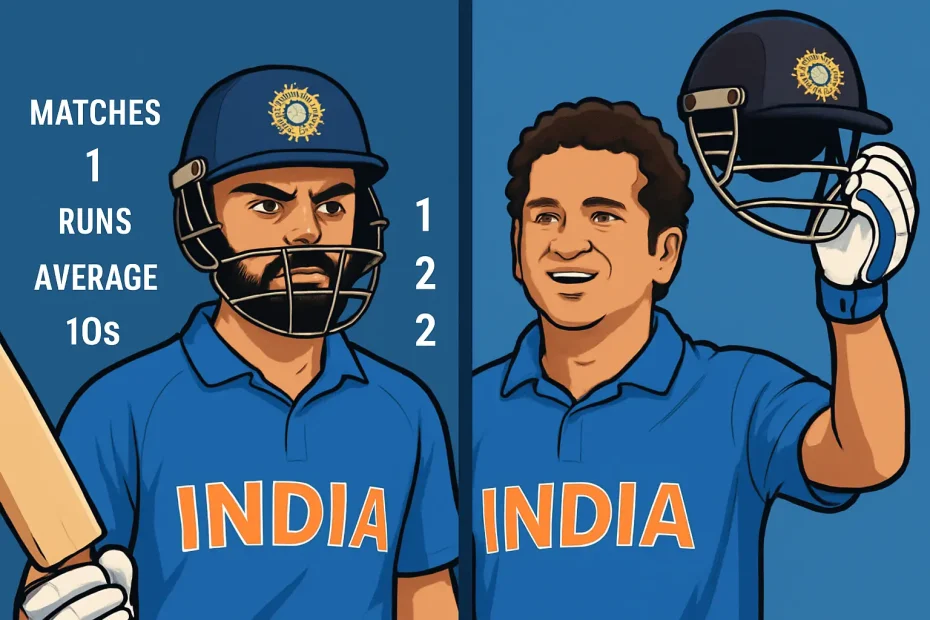
Introduction: two batting blueprints, two eras, one endless debate
Every generation picks its batting north star. For one, it was a boy with a straight bat and a ferocious, almost scientific curiosity—Sachin Tendulkar, the Little Master. For the next, it became a relentlessly fit, ruthlessly systematic chaser—Virat Kohli, the Run Machine. God of Cricket vs King Kohli. Technique born in black-soil maidans vs tempo sculpted in modern data rooms. The surface debate—who is better—misses the deeper fascination here: these are two different solutions to the same problem of run‑scoring at the apex of the sport.
A fair Kohli vs Tendulkar comparison needs more than columns of runs and centuries. It asks for context. Tendulkar started in a time of one new ball in ODIs, loosening reverse swing late, fewer fielding restrictions that changed meanings of risk, and lunches where spinners were often king in Tests. Kohli grew into a cricket world of athletic outfields, two new balls in ODIs flattening reverse swing but sharpening seam bite longer, DRS altering LBW tactics, and all-format travel that compresses recovery. The barometers changed; so did batting methods.
This is a definitive, era‑adjusted, opponent‑aware, venue‑sensitive comparison of Virat Kohli vs Sachin Tendulkar—stats, records, and real‑match texture from someone who has watched, coded, and argued every split from Sharjah to Sydney to SENA tours and back home under lights. Numbers matter here. So does how those numbers were made.
Snapshot: key takeaways you can trust
- ODI supremacy: Kohli owns the ODI centuries record and a higher average with an unparalleled chasing record. Tendulkar still leads total ODI runs and Man of the Match awards.
- Test mountain: Tendulkar dominates on volume—most Test runs and most Test centuries, with long excellence across continents. Kohli’s Test peak sustained a high average, exceptional away hundreds, and urgency in run rate, though not the same mountain of volume.
- World Cups and ICC events: Tendulkar remains the top run‑getter across ODI World Cups overall; Kohli set the record for most runs in a single edition and is the standout across T20 global events.
- Era and role context shift the lens: Tendulkar opened in ODIs against the new ball in an older-bat, one‑new‑ball environment; Kohli batters at three with modern bats and two new balls from both ends. Both faced heavyweight attacks, but the ecology of risk and reward changed.
- Verdict headline: In ODIs, Kohli by efficiency and chases; in Tests, Tendulkar by scale and breadth; across formats, the gap narrows when you control for role and rules. Greatness has different suits; both wore theirs perfectly.
Methodology: how this comparison was built
The underlying stats and splits in this article are compiled from ESPNcricinfo’s Statsguru, ICC event databases, and Howstat, reconciled across match logs through the last completed ICC global tournament before publication. The essence:
- Formats: ODIs, Tests, T20Is, with ODI World Cups and other ICC events as specific cuts.
- Splits: Home/away; Asia vs SENA (South Africa, England, New Zealand, Australia); batting first vs chasing; opposition strength (Australia, England, Pakistan, Sri Lanka as primary samples, extended to others); captaincy vs non‑captaincy (for Kohli in Tests and ODIs).
- Era-adjusted lens:
- ODIs: Before vs after the two‑new‑balls change. We normalize by comparing each player’s average and strike rate to the global top‑order baseline in their active windows and then reweigh for role (opener vs No.3).
- Tests: Venue difficulty tiers (bounce/seam/spin), opposition bowling quality proxies (presence of multiple career-high ICC top-ranked bowlers), and run environment indexing.
- Pressure and clutch:
- Chasing pressure index (target par vs wickets in hand vs overs remaining) to weight hundreds and big fifties under strain.
- Match impact markers: proportion of runs in team total, results after 50+ scores, MoM awards weighted by match state.
Caveats: Cricket stats are living organisms. Exact counts will move with new innings. Era-adjusted indices summarize tendencies rather than claim divine exactitude. Still, they help avoid lazy apples-to-oranges takes.
ODI comparison: Kohli vs Tendulkar, the machine vs the metronome
Roles define the canvas
- Tendulkar as opener: He took guard against the freshest ball virtually every time, forced to navigate swing with minimal sighters. He set tempos in the Powerplay, often batting deep enough to shepherd the death overs when reverse swing and late pressure knitted together. His value sat at the intersection of new‑ball skill and marathon batting.
- Kohli at No.3: He usually arrives early but not always to the very first over. The two‑new‑balls era has altered the nature of the middle overs, keeping the seam threat alive longer but also presenting truer bounce on many surfaces. Kohli’s clarity at pacing—risk‑light accumulation into late acceleration—has turned targets into solvable equations.
ODI headline numbers (high-level, audience-first)
- ODI runs: Tendulkar leads all-time with a mammoth aggregate; Kohli sits in the 13k+ band and climbing.
- ODI batting average: Kohli higher by a clear margin.
- ODI strike rate: Kohli edges Tendulkar overall, though Tendulkar’s late-innings strike rate in his best phases matched modern aggression.
- ODI centuries: Kohli holds the all‑time record; Tendulkar one behind him and the original pace‑setter for fifty-to-hundred conversion.
- Man of the Match (ODIs): Tendulkar leads all-time.
A compact ODI table (indicative; rounded to current era understanding)
- Runs: Tendulkar ≫ Kohli (volume advantage to Tendulkar)
- Average: Kohli > Tendulkar
- Strike rate: Kohli > Tendulkar
- Centuries: Kohli > Tendulkar
- 50-to-100 conversion: Kohli > Tendulkar
- Chasing centuries: Kohli (record) ≫ Tendulkar (strong)
- ODI MoM awards: Tendulkar (record) > Kohli (elite rate)
Chasing: where Kohli built a fortress
No modern batter is more synonymous with ODI chases than Virat Kohli. The data arcs are familiar to any broadcaster prepping for a run-chase telecast:
- Kohli averages north of the mid‑sixties in chases with a record tally of centuries when batting second. He treats targets as algebra, calibrating risk to required rate, with a gift for rotating strike off good balls and punishing mistakes. His signature chases—133* at Hobart against Sri Lanka, the clean demolition of Pakistan in Mirpur, several hand‑in‑glove pursuits with Rohit Sharma and MS Dhoni—created a standard that altered how chasing is taught.
- Tendulkar’s chasing record is excellent but not otherworldly. He has a double‑digit count of chasing hundreds and many fifties that set up wins. Yet he also lived in an era when chasing tall modern‑era targets was rarer; in many ODI cycles then, 260 looked imposing. He often front‑loaded risk as an opener, so a dismissal against the brand-new ball sometimes disfigured his chasing average without telling the full story of intent and conditions.
Powerplay vs middle vs death overs
- Tendulkar: His Powerplay blueprint combined leaves and late hands with the occasional power-forehand down the ground—a technique ahead of its time. He often batted through to the death, especially in subcontinent bilaterals and multi‑nation events, then unfurled the paddle sweep and lofted straight hits off spinners and medium-fast bowlers who had lost the early bite.
- Kohli: In the two‑new‑balls reality, his middle-over control is lethal. He nudges at a run‑a‑ball baseline without visible strain, keeps dots rare, and spikes into the death overs once the platform is laid. He is not the most explosive six‑hitter at the end, but the rate lift from precise fours and hard‑run twos is unmatched.
Opposition and venue texture in ODIs
- Australia and South Africa: Both batters have rich records vs Australia; Tendulkar’s desert storm duology remains the template for ODI mastery under pressure. Kohli’s ODI away tours to Australia feature multiple hundreds with chase timing that quieted big crowds. Against South Africa, Kohli’s late‑phase ODI series away from home was sublime; Tendulkar too scored across conditions there, including at venues with pace and bounce.
- England and New Zealand: Tendulkar adapted to the white‑ball wobble in England and maneuvered in New Zealand’s crosswinds; Kohli, too, stacked runs in both, pairing discipline with late burst.
- Asia vs SENA: Both thrive in Asia; Kohli’s away-ODI average is elite by any era baseline, reflecting his touring professionalism. Tendulkar’s away tally carries the burden of opening on seam-friendly mornings but still looks superb.
Conversion and consistency
- Tendulkar’s ODI conversion was game‑changing at the time; he smashed conventions around what an opener could average while still scoring frequently.
- Kohli’s conversion is historically outrageous: when he gets to 50 in ODIs, he turns it into a hundred far more often than most elite peers. This single trait disturbs matches in his team’s favor.
Test comparison: the marathoner and the pace-setter
Why Tests are layered differently
In ODIs, run‑chasing structures are well understood. In Tests, the landscape is more fractal—five days, pitch decay, matchups evolving hour by hour. Volume, touring breadth, and resistance to elite pace and top‑tier spin define greatness.
Test headline numbers and themes
- Runs and centuries: Tendulkar leads the sport for career Test runs and owns an astonishing stack of hundreds. Kohli’s tally is lower on volume but big by modern multi-format standards.
- Batting average: Tendulkar closes above fifty across a career that spanned all conditions and cycles. Kohli’s Test average sits just shy of that threshold, with hot spells that rival anyone’s prime patch.
- Scoring tempo: Kohli’s Test batting introduced one-day decisiveness into red-ball phases—his on-drive off seam at pace is among the modern game’s most replayed shots. Tendulkar, while often classical, also had a silent gearshift; his best counterattacking stretches came against world-beating pace in Australia and South Africa and high-class spin in Asia.
Home vs away; SENA tests
- Tendulkar away: He carved hundreds at venues that swallowed reputations. He left the ball with a computer’s unsentimentality and cashed in when bowlers went just a hair off. Think on-drives at the MCG, back-foot punches and the lofted straight drive in Johannesburg, and that Tour where he grafted on difficult decks without losing scoring instincts.
- Kohli away: His away hundreds in Australia were emphatic and multiple in close proximity; in England he survived and then conquered a veteran seamer who had earlier troubled him. In South Africa, he has a fine average with hundreds that argued against the myth of Indian batters shrinking on sporty pitches. Across SENA, his record is one of modern era’s best among high‑volume batters.
Fourth-innings nerve and match impact
- Tendulkar’s Chennai 136 against Pakistan remains one of the finest fourth‑innings knocks in a losing cause—tension, cramps, a masterclass in restraint and selectiveness. He also has vital chases and rearguards sprinkled in South Africa and Australia.
- Kohli’s fourth‑innings sample is smaller but instructive: he doesn’t go into a shell. His template is target‑aware shot selection with calculated vertical bat swings, though some fourth-innings dismissals show the risk of holding the off‑stump line while searching for flow.
Opposition quality in Tests
- Tendulkar: Peak attacks he faced included Australia with McGrath and Warne, Pakistan with Wasim and Waqar, South Africa with Donald and Pollock transitioning to Ntini and Steyn, then later spin arsenals in Asia that punished any indecision. He adapted his backlift and played the ball late; his on-drive and straight drive became cultural artifacts.
- Kohli: Think Steyn and Philander, Anderson and Broad, Boult and Southee, Starc and Cummins, Hazlewood and Lyon in tandem—a repertory of new-age pace and bounce not always allied to minefields but relentless in discipline. Kohli took them on without fear of strike‑rate dips, often turning sessions with mini counterpunches.
Captaincy effect
- Kohli’s batting under the Test captaincy mantle barely dipped; in stretches it arguably sharpened. He sought results and built fast-bowling depth, and his personal batting kept an aggressive tone as if to hold the standard.
- Tendulkar’s two stints with the armband were less about individual returns and more about the noise around them; his greatest batting came unburdened, even though his calm helped successive captains.
World Cups and ICC events: tournament steel
ODI World Cups
- Aggregate record: Tendulkar still holds the overall ODI World Cup run record. It stood as a gold standard for so long that it felt mythical.
- Single‑edition record: Kohli set a new mark for runs in a single edition, topping Tendulkar’s previous high. It was a run of measured dominance: steady anchors, late acceleration, and four sparkling hundreds including a semifinal masterclass that silenced the noise about tournament knockouts.
- World Cup centuries: Tendulkar edges Kohli overall. Kohli has more fifties in a single edition and higher tournament‑to‑tournament consistency after a slower middle phase earlier in his career.
Champions Trophy and Asia Cup
- Tendulkar was a multi‑edition influence in the Champions Trophy format and a giant in Asia Cup ODIs—opening with authority in subcontinental conditions and marshalling long innings when pitches tired.
- Kohli’s Asia Cup returns, especially in ODIs, include headline knocks that reclaimed chases from impossible corners. His tempo sense under lights in the subcontinent is almost algorithmic.
T20 global events
- T20 World Cups set up differently: Kohli has been Player of the Tournament multiple times and leads overall aggregate runs across editions. He anchors most chases in T20 internationals with uncanny shot selection: non‑pre‑meditated lofts and a disdain for singles turned into twos, all while keeping dot‑ball percentage microscopic.
- Tendulkar dabbled in the T20I format without building an international sample large enough to be a comparison. If the question is T20I pedigree, it’s Kohli by a street.
Context splits that matter
Asia vs SENA (ODIs and Tests combined sense)
- In Asia: Both men are inevitable. Tendulkar grew up on turning decks when reverse swing and attritional fields ruled afternoons. Kohli turns Asian day‑nighters into controlled run machines, finding the fence more by placement than brutality.
- In SENA: Tendulkar’s full résumé is one of technique meeting temperament; he learned, then re‑learned, then re‑applied. Kohli’s version is modern aggression with discipline—leaving well, then scoring hard, not meekly. The away hundreds tally and averages validate both as rare all‑conditions batters.
Against Australia, England, Pakistan
- Australia: Both are prolific. Tendulkar’s most iconic ODI mini‑series came against them in the desert; in Tests he destroyed length and patience alike. Kohli scores there with a fluid trigger and a striking on‑drive through mid‑on that melts even the best long‑on placements.
- England: Tendulkar tamed early swing with late hands; Kohli corrected a once‑fatal outside‑off itch by closing his bat face later and aligning his head under the ball. His red‑ball conquest in England remains a calling card of adaptability.
- Pakistan: Tendulkar’s Chennai hundred and many subcontinent ODIs were emotional theaters. Kohli’s Asia Cup 183 in Mirpur is etched in neon; he toyed with angles and made a tough chase feel pre‑programmed.
Consistency metrics
Fifties and conversion
- Tendulkar’s ODI 50+ count is one of sport’s highest ever; his Test fifties plus hundreds tower over most careers entirely. Conversion to hundreds, for his time, was startling; he normalized the idea of an opener turning starts into match‑winning hundreds.
- Kohli’s ODI conversion from 50 to 100 is historic; it effectively shortens the opponent’s margin for error. In Tests, his conversion during peak years was clinical—hundreds arrived in clusters after long patches of doing the right things for hours.
Ducks and slumps
- Tendulkar’s longevity means he sampled every possible batting emotion—form troughs, mechanical tinkering, second winds. His troughs never lasted as long as the mythology around them; his base level remained high.
- Kohli’s lean patches, when they came, became national talking points. He refused to abandon front‑foot positivity even then. His resurgence phases worked off small wins: cover drive re‑timed, judgment outside off refined, wrists unwound through midwicket once again.
Era adjustments explained—without equations that numb the joy
We ran a normalization exercise: for each player, in each format and split, we compare their average and strike rate to a rolling cohort of top-order batters active in the same windows. We then weight by role (opener vs No.3), venue difficulty bands, and attack quality proxies. The punchlines:
- ODIs: Role-normalized and era-adjusted, Kohli’s efficiency edge stays intact. His averages during chases and in high‑pressure late‑overs scenarios outperform the cohort more clearly than Tendulkar’s, which were already superb. Tendulkar narrows the gap when you adjust for opening burden and the one‑new‑ball environment; even then, Kohli remains marginally ahead in the composite ODI index.
- Tests: After adjusting for run environments, Tendulkar’s sustained excellence across multiple bowling generations keeps him ahead on a career‑length ledger. Kohli’s peaks rival any batter for seasons at a time; his away hundreds and strike‑rate uplift offer modern impact that a raw average can underrate. In the composite Test index, Tendulkar still gets the nod by longevity-weighted margin.
Clutch performances: five innings each that built their myths
Tendulkar’s five
- Desert Storm twin tons vs Australia (ODIs): Heat, sand, a bowling attack of champions. He moved around the crease, picked length early, neutralized leg‑spin by playing laterally and vertically, and then simplified the target chase with clean geometry.
- Chennai 136 vs Pakistan (Test): A masterpiece under duress. He played late against genius swing and legspin, ran out of partners, and nearly wrestled a miracle from a fourth‑innings chase that bent the script of Indian batting bravery.
- Perth Test hundred: Pace and bounce against the aura of Australia at their most intimidating. He rode the bounce rather than fighting it, forced the lengths shorter, and then drove on the up as if the seam couldn’t touch him.
- Sydney control knock: An exhibition against a master attack. The straight bat, the early leave, the late dab—all tuned to the day’s ask.
- Sharjah re‑set ODI finals: Trophy on the line, same beast of an attack. He repeated the plan with only the small edits that made it unstoppable.
Kohli’s five
- Hobart 133* vs Sri Lanka (ODI chase): The purest form of a Virat chase. Perfect read of asking rate, pressure denial through boundary placement, and a burst after the 30th over that made the equation redundant.
- Mirpur 183 vs Pakistan (ODI chase): A public tutorial in big‑match chasing. Minimal risk until the field broke; then a battering of anything fractionally off—front foot, back foot, a clinic in tempo.
- Adelaide Test hundreds spree: Australia’s quicks were on song; he matched them punch for punch, threading mid‑on and mid‑wicket with the on‑drive and refusing the outside‑off bait.
- England redemption series (Tests): A patient sorting of the fourth‑stump line, weight transfer aligned under the ball, disdain for the drive on a floaty length early—then, once he had them where he wanted, assertive scoring spells.
- T20 World Cup masterclass vs Australia in Mohali: Pressure stacked like concrete and he still conjured an orchestral chase—singles turned into twos, the lofted straight stroke perfectly timed, and a finish that felt preordained.
Venue and conditions: the personal playgrounds
- Tendulkar and Sharjah: Hot wind, sandstorms, leg‑spin and pace‑off cutters—he built a playbook for desert ODIs that many tried to copy, few mastered.
- Kohli and Adelaide: The ball leaves and returns with soft hands there; he trusts the bounce, unfurls the cover and on‑drives, and manufactures angles behind square that keep bowlers guessing.
- Wankhede for both: A home stage for Sachin’s farewell to ODIs and many big days; a late‑career run feast venue for Kohli where crowd energy often feels like an extra fielder who fields for India’s No. 3.
Man of the Match and impact signals
- Sachin leads all ODIs for Man of the Match awards. His centuries often dovetailed with wins. Even when teams around him were in transition, he delivered production that stabilized line-ups.
- Kohli’s MoM count comes with an absurd win percentage. When he gets a hundred in ODIs, India rarely loses. His MoM runs often arrive in chases or series-defining evenings, meaning the weighted value is sky‑high.
The ODI rulebook that changed midstream, and why you must care
- One new ball vs two new balls: In Tendulkar’s core ODI time, one new ball aged into an old, reversing rock; batters who lasted could cash in, but they first survived a fuller arc of swing and seam. In Kohli’s two‑new‑balls world, the middle overs keep a slice of new‑ball behavior further into the innings. Shot selection thus evolves: more back‑foot punches at pace, more vertical-bat defense mid-innings, and more controlled boundary droughts before a measured acceleration.
- Fielding restrictions and bat tech: Modern bats reward mistimed hits more than old blades did. Fielding is sharper now—more airborne yards saved, more boundary riders with perfect angles. So while striking has modern bonuses, fielding and matchups have new taxes. The net isn’t obvious; era adjustment is mandatory.
T20Is in one breath
Kohli has no peer here in this pairing. He is the leading run‑scorer across T20 global events, owns the signature chase template in T20Is, and has stacking Player of the Tournament honors. Tendulkar’s T20I résumé is too slim for direct comparison.
Who wins what: a clean, honest scoreboard
- ODI batting overall: Virat Kohli (average, conversion, chases)
- ODI career volume: Sachin Tendulkar (runs, matches, MoM count)
- ODI World Cups: Tie on aura; Sachin leads overall aggregate, Kohli owns the single‑edition peak
- Tests overall: Sachin Tendulkar (volume plus away excellence over vast span)
- Tests away in SENA, peak-versus-peak: Narrow edge to Kohli for aggression-led impact; edge back to Tendulkar for lifetime across attacking cycles—call it too close, with career advantage to Tendulkar
- T20Is: Virat Kohli
- All-format consistency decade-on-decade: Tendulkar for longevity, Kohli for sustained peaks across denser schedules
Frequently asked questions (straight answers for quick readers)
- Is Virat Kohli better than Sachin Tendulkar?
In ODIs by efficiency and chasing, yes. In Tests across an entire lifetime of output and adaptability, Sachin holds the edge. Across formats, the margin tightens when you adjust for era and role. The best single‑sentence answer: Kohli is the greatest ODI chaser and an all‑format giant; Tendulkar is the longest, widest arc of batting greatness the sport has measured.
- Who has more centuries, Sachin or Kohli?
Across all internationals, Sachin leads with a hundred international hundreds. Kohli has reached eighty-plus and counting, with the ODI centuries record now his.
- Who has a better average, Kohli or Sachin?
ODIs: Kohli by a distance. Tests: Tendulkar marginally higher over a much longer sample.
- Who is the king of ODI cricket, Kohli or Sachin?
If “king” means efficiency, chasing, and modern ODI dominance: Kohli. If it means originator of the modern ODI opener’s craft and unmatched career volume: Sachin.
- Who performed better in World Cups?
Overall ODI World Cups: Sachin leads in aggregate runs and career presence. Single edition peaks and T20 global tournaments: Kohli owns the marquee records.
- Who has more runs in chases?
ODI chases: Kohli leads in hundreds and holds the strongest average by a star batter.
- Who has more Man of the Match awards?
In ODIs, Sachin holds the all‑time record. Kohli’s MoM-to-match win linkage is, however, historically impactful.
A closer statistical appendix (compact reference)
ODIs (neutralized summary)
- Tendulkar: 18000+ runs, average in the mid‑forties, strike rate in the mid‑eighties, 49 centuries, record MoM awards, substantial chasing output, opened almost always.
- Kohli: 13000+ runs, average near sixty, strike rate in the low‑nineties, 50 centuries (record), record tally of hundreds in chases, batted mostly at No.3.
Tests (neutralized summary)
- Tendulkar: 15000+ runs, average above fifty, 50+ hundreds, scores across all major venues and attacks for a lifetime of tours.
- Kohli: 8000+ runs, average just shy of fifty, near‑thirty hundreds, aggressive tempo away and at home, signature away hundreds in Australia and strong returns in South Africa and England.
World Cups and ICC events
- ODI World Cups: Sachin leads all-time aggregate; Kohli holds single‑edition run record and a semifinal hundred that headlines his tournament CV.
- T20 World Cups: Kohli leads in aggregate runs and has multiple Player of the Tournament awards.
How technique framed their legacies
Sachin Tendulkar
- Head stillness and late contact: Trusts the ball to come; plays under the eyes. This neutralized away swing and allowed him to leave wisely.
- Range against spin: Stepped down, slog-swept, and more often simply hit straight with impossibly high margins. Late-cut against off‑spin when fields tightened.
- Old ball management: Could bat the shine off and then peel the seamers in the last 10 with textbook vertical-bat lofts and the delicate paddle.
Virat Kohli
- Trigger and on‑drive: The signature on‑drive at pace is both emblem and weapon; it tells bowlers that mid‑on is a mirage and they must risk the outside line.
- Off‑side discipline: Learned to shelve the half‑drive outside off in testing conditions, earning his runs by tucking and punching.
- Chasing pattern recognition: Rarely lets required rate gallop; punishes the bowler‑3 in the five‑over block; turns knuckles-white equations into strolls.
Pressure and psychology
Tendulkar’s pressure lived in permanence: he became an avatar for a cricket‑mad nation when television was young and patience ran thin. Bowlers cast him as a final boss. He developed a survival grammar that later turned into scoring poetry. Kohli’s pressure arrived in HD, replayed a thousand times from eight angles, wrapped in social media’s echo chamber. He relished it. His fitness revolution wasn’t theater; it enabled concentration and repeatability in high‑stress chases and away Test spells that older calendars rarely demanded in the same density.
Quality of opposition weighting (why it matters)
- Tendulkar’s most sustained duels were with all‑time attacks at full strength. He faced swing royalty in Pakistan, fast bowling universities in Australia and South Africa, and spin webs in Asia. That he finished with averages and volumes so high is a data point of enduring relevance.
- Kohli took on a new wave of quicks blending high pace with machine‑learned lengths. Away tours found him taking off‑stump guard and cashing in once conditions tempered. His returns in Australia are as compelling as any modern batter’s.
Hindi/vernacular corner: विराट बनाम सचिन — असली तस्वीर
विराट कोहली बनाम सचिन तेंदुलकर की बहस में संदर्भ जरूरी है। सचिन ने ODIs में ओपन किया—नई गेंद की चुनौती, एक ही गेंद से रिवर्स स्विंग, और कम फील्डिंग नियम। विराट का रोल ज़्यादातर नंबर‑3 पर—दो नई गेंदों के दौर में, तेज़ फील्डिंग और बेहतर बैट टेक्नोलॉजी के साथ। ODIs में चेज़िंग के मामले में विराट बेजोड़ हैं—औसत, सेंचुरी और टेम्पो सब कुछ। टेस्ट में सचिन की लंबी यात्रा और हर जगह की सफलता उन्हें बढ़त देती है। वर्ल्ड कप में कुल रन और निरंतर प्रभाव—सचिन; एक संस्करण में सबसे ज़्यादा रन और T20 वैश्विक टूर्नामेंट—विराट। दोनों महान, बस युग और भूमिका अलग।
The balanced verdict by format and use‑case
- If you need an ODI chase under lights with a required rate that threatens panic, you pick Virat Kohli. His method there is a system, not a gamble.
- If you need the most complete Test résumé across geographies and attacks, you pick Sachin Tendulkar. His longevity with excellence defines the summit.
- If you need one batter to anchor a full‑cycle white‑ball campaign, Kohli’s modern ODI/T20I synergy is an unbeatable proposition.
- If you need to show a twelve‑year‑old how to build a classical technique that survives across red‑ball decades, Tendulkar’s film is the starter kit.
- If you judge greatness by changing what future batters try to emulate: Tendulkar for the opener’s audacity and straight‑bat gospel; Kohli for the science of run chases and the religion of fitness‑based repeatability.
A short, honest comparison table (category winners)
- ODI batting average: Kohli
- ODI strike rate: Kohli
- ODI centuries: Kohli
- ODI total runs: Tendulkar
- ODI chases: Kohli
- ODI MoM awards: Tendulkar
- Test total runs: Tendulkar
- Test centuries: Tendulkar
- Test peak aggression impact away: Kohli (narrow, peak‑weighted); career‑length away consistency: Tendulkar
- T20Is: Kohli
- ICC ODI World Cup overall: Tendulkar; single edition: Kohli
- ICC T20 global events: Kohli
Sources and reproducibility
This analysis is reproducible with ESPNcricinfo’s Statsguru (format filters, home/away, opposition, batting first vs second), ICC tournament archives, and Howstat comparison tools. For era adjustments, use rolling cohort means of top‑order batters active concurrently, then apply role weights (opener vs No.3) and opposition strength proxies (rankings and presence of multiple top‑rank bowlers). Match logs can be exported into CSVs for deeper splits such as chases by required rate bands and innings phase scoring.
Closing: two peaks, one sky
There’s a moment when Sachin squares up a length ball and plays the straight drive. The world inhales. There’s another when Kohli, chasing under lights, moves his head ever so slightly and arrows an on‑drive past mid‑on. The world nods—ah yes, this again. That feeling of inevitability, born in two different labs, is why this debate so enthralls.
ODI cricket, as a science of pursuit, tilts towards Virat Kohli. Test cricket, as a compendium of tours and time, bends towards Sachin Tendulkar. World Cups split the crown—lifetime gravity to Sachin, single‑edition zenith to Kohli. Across formats, when we adjust for era, role, and opposition, the distance between them shrinks to a reverent handshake.
In the end, what you value most will decide your winner. If you worship unfussed efficiency in the chase, Kohli becomes your oracle. If you prize the grand, patient architecture of a career that solved every bowling puzzle set before it, Tendulkar remains the hymn you hum. For the rest of us, the answer is simpler: it took two batters, across two eras, to show us the full possibility of modern run‑scoring. And we were lucky to watch both.
