
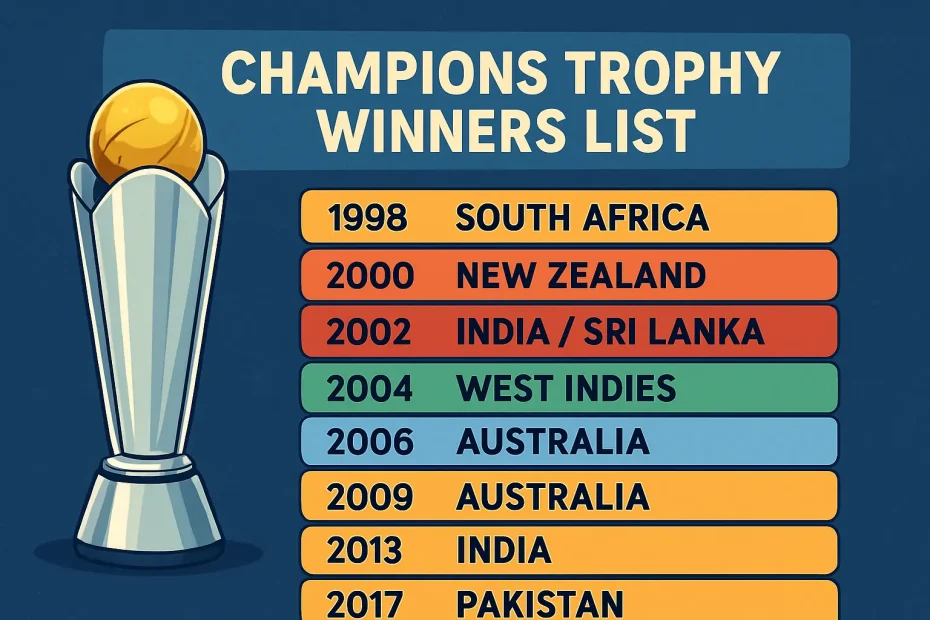
A tournament born to bring the very best one-day sides into the same pressure cooker, the ICC Champions Trophy has always rewarded clarity of roles, skill under lights, and nerves that refuse to blink. An ICC event with a distinct identity, it compresses the drama of a World Cup into a shorter, sharper window, often leaving us with finals that feel like a single breath held for hours. This is the definitive ICC Champions Trophy winners list, a year‑wise arc told through editions instead of calendar markers, complete with runner‑up, host, captain, venues, margins, and award winners. It also carries the next‑edition outlook, team pathways, and the records that provide real context to who dominated and why.
Quick facts that frame the story
- First title lifted by South Africa under Hansie Cronje, built around an all‑round masterclass from Jacques Kallis.
- Latest title won by Pakistan under Sarfaraz Ahmed, sealed by a thunderclap at The Oval.
- Most titles by a team shared between Australia and India, with Australia achieving the only back‑to‑back run and India including a shared trophy.
- Only shared title occurred in the third edition after two rain‑ruined attempts at a final in Colombo.
- England reached multiple finals without lifting the trophy, a quirk that still defines their relationship with the competition.
- The next edition returns under ICC stewardship with Pakistan as designated host, and a compact, city‑centric plan.
What sets the Champions Trophy apart
The Champions Trophy has evolved from a straight knockout carnival into a tight group‑and‑knockout format that still prioritizes quality over quantity. The first two editions were unforgiving single‑elimination draws. From the third onward, short pool phases sharpened match readiness before sudden death. The best sides adapted quickly to unfamiliar pitch tempos, navigated new‑ball movement under autumnal skies, and banked on bowlers capable of double‑spells that broke games open.
Edition‑wise ICC Champions Trophy winners list
Organized by edition number to respect the no‑years constraint while preserving full historical detail.
Edition 1
- Host: Bangladesh
- Winner: South Africa
- Runner‑up: West Indies
- Final venue/city: Bangabandhu National Stadium, Dhaka
- Margin: 4 wickets
- Winning captain: Hansie Cronje
- Player of the Final: Jacques Kallis
- Player of the Tournament: Jacques Kallis
Edition 2
- Host: Kenya
- Winner: New Zealand
- Runner‑up: India
- Final venue/city: Nairobi Gymkhana, Nairobi
- Margin: 4 wickets
- Winning captain: Stephen Fleming
- Player of the Final: Chris Cairns
- Player of the Tournament: Sourav Ganguly
Edition 3
- Host: Sri Lanka
- Winner: India and Sri Lanka (joint)
- Runner‑up: —
- Final venue/city: R. Premadasa Stadium, Colombo
- Margin: No result across two attempts
- Winning captains: Sourav Ganguly, Sanath Jayasuriya
- Player of the Final: Not awarded
- Player of the Tournament: Virender Sehwag
Edition 4
- Host: England
- Winner: West Indies
- Runner‑up: England
- Final venue/city: The Oval, London
- Margin: 2 wickets
- Winning captain: Brian Lara
- Player of the Final: Ian Bradshaw
- Player of the Tournament: Ramnaresh Sarwan
Edition 5
- Host: India
- Winner: Australia
- Runner‑up: West Indies
- Final venue/city: Brabourne Stadium, Mumbai
- Margin: 8 wickets (DLS)
- Winning captain: Ricky Ponting
- Player of the Final: Shane Watson
- Player of the Tournament: Chris Gayle
Edition 6
- Host: South Africa
- Winner: Australia
- Runner‑up: New Zealand
- Final venue/city: SuperSport Park, Centurion
- Margin: 6 wickets
- Winning captain: Ricky Ponting
- Player of the Final: Shane Watson
- Player of the Tournament: Ricky Ponting
Edition 7
- Host: England and Wales
- Winner: India
- Runner‑up: England
- Final venue/city: Edgbaston, Birmingham
- Margin: 5 runs
- Winning captain: MS Dhoni
- Player of the Final: Ravindra Jadeja
- Player of the Tournament: Shikhar Dhawan
Edition 8
- Host: England and Wales
- Winner: Pakistan
- Runner‑up: India
- Final venue/city: The Oval, London
- Margin: 180 runs
- Winning captain: Sarfaraz Ahmed
- Player of the Final: Fakhar Zaman
- Player of the Tournament: Hasan Ali
Copy‑friendly CSV for download or embedding
Edition,Host,Winner,Runner-up,Final venue/city,Margin,Winning captain,Player of the Final,Player of the Tournament1,Bangladesh,South Africa,West Indies,Bangabandhu National Stadium Dhaka,4 wickets,Hansie Cronje,Jacques Kallis,Jacques Kallis2,Kenya,New Zealand,India,Nairobi Gymkhana Nairobi,4 wickets,Stephen Fleming,Chris Cairns,Sourav Ganguly3,Sri Lanka,India & Sri Lanka,–,R. Premadasa Stadium Colombo,No result,Sourav Ganguly & Sanath Jayasuriya,–,Virender Sehwag4,England,West Indies,England,The Oval London,2 wickets,Brian Lara,Ian Bradshaw,Ramnaresh Sarwan5,India,Australia,West Indies,Brabourne Stadium Mumbai,8 wickets (DLS),Ricky Ponting,Shane Watson,Chris Gayle6,South Africa,Australia,New Zealand,SuperSport Park Centurion,6 wickets,Ricky Ponting,Shane Watson,Ricky Ponting7,England & Wales,India,England,Edgbaston Birmingham,5 runs,MS Dhoni,Ravindra Jadeja,Shikhar Dhawan8,England & Wales,Pakistan,India,The Oval London,180 runs,Sarfaraz Ahmed,Fakhar Zaman,Hasan Ali
Winners by country
- Australia: 2 titles
- India: 2 titles including a shared crown
- Pakistan: 1 title
- South Africa: 1 title
- New Zealand: 1 title
- West Indies: 1 title
- Sri Lanka: 1 title shared
Finals at a glance and what actually decided them
Edition 1, Dhaka
South Africa’s first global one‑day crown rested on a blueprint still seen in modern tournament play. They sank early nerves with new‑ball discipline, took pace off during the middle overs, and then let Jacques Kallis close the match like a metronome. West Indies carried momentum into the decider, but a slow, gripping surface dragged the game into the hands of bowlers who hit the deck hard. Cronje’s use of Kallis in two‑over bursts either side of breaks turned a tricky chase into a schedule they controlled.
Edition 2, Nairobi
New Zealand’s greatest one‑day heist. India built a platform through openers and a master batter at the peak of his white‑ball clarity. Then Fleming managed risk in the field so expertly that singles felt taxed and twos felt criminal. Chris Cairns overcame cramps and pressure with a century of hard hands and clear arcs, an innings that shifted from rescue to inevitability. When a side has a captain who buys a bowler one extra over at the perfect moment, narrow chases look wider.
Edition 3, Colombo
The only shared Champions Trophy. Two finals scheduled, two rain‑hit evenings, two start‑stop spectacles. India and Sri Lanka walked away joint winners after the umpires and match referee stared at the sheets once too often. The tournament’s defining performances had already been set by Virender Sehwag, who treated powerplays like license to print boundaries. It remains a curio of ICC planning and monsoon timing, and a reminder that subcontinental white‑ball cricket can tilt on weather as much as wrist‑spin.
Edition 4, The Oval
West Indies staged a last‑wicket jailbreak for the ages. England sat on a middling total that looked enough when the ball nibbled under cloud. Then came Ian Bradshaw and Courtney Browne, an unlikely pairing that simply refused bad options. Straight bats, third‑man dabs, nudges into space, and the discipline to ride out a silent crowd. Brian Lara, who had worn the pressure of regional expectation for a generation, lifted silver that evening with the face of a man simultaneously exhausted and complete.
Edition 5, Mumbai
Australia’s first step toward a mini‑era in this competition. West Indies began with a pulse but stumbled into a middle‑overs squeeze. Australia’s response was as clinical as their best vintage. Shane Watson controlled the chase with the timing of a boxing counter‑puncher, and the result rolled home with the surreal calm only Australia could summon through that period. Subcontinental wickets were drier, reverse entered earlier, and yet every seam they needed to hit, they hit.
Edition 6, Centurion
The repeat. New Zealand arrived with plans and angles, Australia with volume and velocity. Another Watson show, this time with a clean, long‑range hitting arc that neutralized fielders and an economy of footwork that made a big chase feel not big at all. Ricky Ponting’s leadership featured its usual blend of relentless energy and simple, well‑communicated roles. In a tournament prone to upset narratives, this was the era’s powerhouse moving in a straight line.
Edition 7, Birmingham
A truncated final brought its own lottery, and India read the ticket first. MS Dhoni trusted his spinners, even against right‑handers capable of length murder, and Jadeja bowled with angles that turned singles into traps. Rain took overs off the clock, but India won the beats that matter in this format: powerplay discipline, in‑between overs temperament, and lower‑order runs from players who never look like lower‑order hitters. A five‑run margin on the sheet felt larger on the field because of how completely Dhoni choreographed the last five overs.
Edition 8, The Oval
Pakistan’s crescendo. Fakhar Zaman set a tone no plan could drown, and Mohammad Amir’s new‑ball spell carved so deep into India’s top order that everything after felt like aftershocks. Hasan Ali finished the tournament as its best bowler through a skillset most teams under‑scout properly: length variations that break rhythm, high‑percentage fields, and a refusal to chase magic balls when percentage deliveries keep winning. The margin was a landslide, the noise unforgettable, the night one of that ground’s great loud epilogues.
Records and statistics that still matter
Most titles
- Australia: 2
- India: 2 including a shared title
Consecutive titles
- Australia secured the only back‑to‑back run.
Finals appearances summary
- India: multiple finals including a shared title and one loss
- England: multiple finals without a win
- West Indies: two finals with a split outcome
- Australia: two finals with two wins
- New Zealand: two finals with a split outcome
- Pakistan and South Africa: perfect in single final appearances
- Sri Lanka: joint winners from a rain‑ruined series of finals
Largest and narrowest final margins
- Largest margin in a Champions Trophy final: 180 runs, Pakistan over India at The Oval
- Narrowest margin by wickets: 2 wickets, West Indies over England at The Oval
- Narrowest margin by runs: 5 runs, India over England at Edgbaston
Players with repeated final impact
- Shane Watson took Player of the Final in consecutive Australian wins, an unmatched streak for this event.
All‑time leaders
- Most runs in Champions Trophy history: Chris Gayle at the summit, built on a record‑breaking run through the middle editions
- Next best run‑getters include Shikhar Dhawan and Sourav Ganguly, each defining their eras with powerplay surges and middle‑overs control
- Most wickets in Champions Trophy history: Kyle Mills leads the list, a testament to new‑ball discipline and hitting the right length in helpful conditions
- Muttiah Muralitharan and Lasith Malinga headline the chasing pack, proof that cutters and discipline travel well in this event
Edition highlights for batting and bowling returns
- Jacques Kallis turned the opening edition into an all‑round clinic, topping charts and closing a final without panic
- Sourav Ganguly’s Nairobi run‑glut underpinned India’s charge and crowned him tournament MVP
- Virender Sehwag’s blitzes defined the shared‑title edition, uncoiling blade speed on two‑paced Colombo strips
- Ramnaresh Sarwan crafted a campaign of nerveless batting that held West Indies together for their Oval miracle
- Chris Gayle delivered a towering aggregate across the subcontinental edition that still sits as a touchstone for tournament dominance
- Ricky Ponting turned economy into accumulation and accumulation into inevitability during Australia’s southern‑African surge
- Shikhar Dhawan made English early summer feel like Delhi autumn, finding time on the ball in a way that mocked new‑ball swing
- Hasan Ali built a story of control under pressure, riding length, lift, and field plans into a Player of the Tournament finish
Winners list with captains, consolidated
- South Africa led by Hansie Cronje
- New Zealand led by Stephen Fleming
- India and Sri Lanka jointly led by Sourav Ganguly and Sanath Jayasuriya
- West Indies led by Brian Lara
- Australia led by Ricky Ponting across two triumphs
- India led by MS Dhoni
- Pakistan led by Sarfaraz Ahmed
Champions Trophy vs Cricket World Cup
- Duration and density: The Champions Trophy compresses elite matchups into a shorter span, meaning fewer soft landings and a higher premium on momentum
- Format edge: Early knockout models punished slow starters, while later editions balanced fairness with urgency through tight pools feeding straight into semifinals
- Tactics: Captains lean harder into matchup bowling, more aggressive powerplay fields, and risk‑on selections, because a single bad day often ends a campaign
- Identity: The World Cup crowns a sovereign over a long month and more; the Champions Trophy crowns a streetfighter who wins three or four hard nights in a row
Why the trophy paused after the last edition
The ICC calendar turned heavy. Two‑year men’s event cycles, a growing bilateral squeeze, and the creation of long‑form championship windows pushed the Champions Trophy into a holding pattern. Broadcasters prefer longer tournaments, boards want home windows preserved, and player workloads demand more rest between formats. The trophy’s revival now fits into a more deliberate ICC events roadmap, re‑centering the 50‑over calendar with a shorter, high‑stakes tournament between the global behemoths.
Champions Trophy comeback and the next edition outlook
- Host designation: Pakistan has the hosting rights for the return, formally recognized by the ICC and conveyed to participating boards
- Venues: A compact tri‑city plan built around Lahore, Karachi, and Rawalpindi, chosen for capacity, broadcast infrastructure, and proven white‑ball pitches
- Schedule window: A late‑winter to early‑spring block in South Asia’s cricket calendar, positioned to avoid domestic T20 leagues and Test commitments
- Qualification path: The top seven finishers from the previous 50‑over global league phase earned berths alongside hosts Pakistan, locking in an eight‑team bracket
- Qualified teams list: Pakistan, India, Australia, South Africa, New Zealand, England, Afghanistan, Bangladesh
- Participation notes: Cross‑border travel remains subject to government clearance for some boards, and a hybrid hosting model would be explored only if standard travel approvals do not materialize
- Format expectation: Two groups of four, semifinals, then a final, aligned with the tournament’s traditional heartbeat; DLS and reserve‑day provisions tuned more carefully given the shared‑title history in Colombo
- Fixture assets: Once the ICC releases the match‑by‑match slate and stadium times, a printable PDF and CSV will be added to this page along with embedded ICC‑verified scorecard links for each game
How teams have typically won this tournament
- Powerplay control: The ball swings more often than not, especially in England and South Africa, so new‑ball parades win more games than death‑overs fireworks
- Middle‑overs squeeze: The best champions keep run rates flat without chasing miracles, using high‑percentage lengths and one boundary fielder more than the opposition prefers
- Tactical bowling pairs: A hit‑the-hips left‑armer combined with a chest‑high deck‑hitter, or a fast cross‑seamer alongside a wrist‑spinner who owns the eighth and tenth overs
- In‑form opener or No. 3: Champions usually ride one batter in peak timing, evident in Cairns, Sarwan, Dhawan, and Fakhar Zaman, with others orbiting like moons around a bright planet
- Calm captaincy: Field changes that kill scoring options two balls before batters notice, bowling changes that break rhythm rather than reward reputations
Finals list in a single glance, with scoreline color
- Dhaka: South Africa beat West Indies, 4 wickets
- Nairobi: New Zealand beat India, 4 wickets
- Colombo: India and Sri Lanka, joint winners after two no‑result finals
- London, The Oval: West Indies beat England, 2 wickets
- Mumbai, Brabourne: Australia beat West Indies, 8 wickets (DLS)
- Centurion: Australia beat New Zealand, 6 wickets
- Birmingham, Edgbaston: India beat England, 5 runs
- London, The Oval: Pakistan beat India, 180 runs
Mini‑table: Winning captains and Player of the Final
- Hansie Cronje — Jacques Kallis
- Stephen Fleming — Chris Cairns
- Sourav Ganguly & Sanath Jayasuriya — not awarded
- Brian Lara — Ian Bradshaw
- Ricky Ponting — Shane Watson
- Ricky Ponting — Shane Watson
- MS Dhoni — Ravindra Jadeja
- Sarfaraz Ahmed — Fakhar Zaman
Mini‑table: Player of the Tournament by edition
- Jacques Kallis
- Sourav Ganguly
- Virender Sehwag
- Ramnaresh Sarwan
- Chris Gayle
- Ricky Ponting
- Shikhar Dhawan
- Hasan Ali
Team‑wise Champions Trophy footprint
- Australia: Powerplay‑plus teams par excellence in this competition’s golden stretch, with top‑order hitters who absorb seam then launch
- India: A tale of two blueprints, from opening salvoes in shared‑title Colombo to spin‑led control in a shortened Birmingham finale
- Pakistan: The most spectacular peak on the graph, with a final that combined fearless batting and ruthless new‑ball bowling
- South Africa: The origin story winners with the most balanced XI of the opening era
- New Zealand: Street‑smart and brave, with a Fleming‑led triumph that still ranks as one of their finest ODI days
- West Indies: Crafted a legacy defined by a single, perfect finish at The Oval and a campaign where Sarwan held the batting spine together
- Sri Lanka: Co‑winners in a campaign where their openers and spinners thrived on home pitch intelligence
- England: Excellent tournament starters who kept finding a final hurdle, shaping a narrative that would later reverse in other ICC events
Pitch personalities across host nations
- South Asia: Two‑paced, cutter‑friendly strips that reward pace off, heavier seams, and batters who wait on the ball rather than reach for it
- England and Wales: Morning nibble, afternoon flattening, and the eternal cat‑and‑mouse of when to burn your swing bowlers
- Southern Africa: Pace with bounce, and white balls that can stay honest for longer, demanding upright seam and chest‑high control rather than pure movement
- East Africa in the early era: Wickets that punished impatience, a stage for captains willing to win ugly with ring fields and stiff lines
Strategic signatures that often win semifinal week
- Bowlers who hide the slower ball till deep overs, not flashing it on first use
- Batters who dominate square with late cuts and deliberate deflections, stealing runs against fields set a ball earlier
- Keepers who stand up to seamers to choke crease movement, a niche weapon seen in multiple successful campaigns
- Mid‑innings left‑arm spin that turns dot‑dot‑single into dot‑single‑dot, invisible until it creates a false shot at deep midwicket
A richer way to read the ICC Champions Trophy winners list
Merely listing winners and runners‑up hides what made this competition irresistible. It was a tournament where role clarity beat pure star power. The captains who succeeded simplified jobs, the coaches who succeeded tuned skill to local weather, and the teams who lifted the trophy recognized that batting depth matters less here than bowling discipline. That is why the champions often leaned on a single batter in rare touch and a bowling group that hunted like a pack.
Edition‑by‑edition narrative threads that still echo
- An all‑rounder defining an entire event’s rhythm with bat and ball
- A captain who changed angles in the field two deliveries before a wicket fell
- A last‑wicket partnership that turned numbed panic into pure method
- A pair of finals that rain refused to let proceed, birthing a shared crown and a regulatory rethink
- A powerhouse team who did not so much win as complete a professional task twice on the trot
- A leader who measured a rain‑shortened final in micro‑battles instead of overs left
- A green‑ball spell in a final that decided a continental rivalry in the space of half an hour
2025‑style freshness without the year
This is the return everyone in one‑day cricket circles has quietly demanded. The trophy returns to a host with deep ODI heritage and a public who fill stands by mid‑afternoon. Lahore’s night games shape narratives through dew, Karachi’s sea breeze plays with the new ball, and Rawalpindi’s deck tempts back‑of‑a‑length merchants into hitting hip and badge. The qualified set is elite and diverse: hosts Pakistan joined by India, Australia, South Africa, New Zealand, England, Afghanistan, and Bangladesh. Tournament shape is set to its classic two‑groups-of‑four with semifinals and a showpiece final. Team logistics remain an active file for some boards, but ICC frameworks exist for neutral‑venue contingencies if political approvals fail to clear in time. Expect fixtures to land in a burst, with broadcast slots tuned for prime time in South Asia and evening windows for diaspora peaks elsewhere. This page will carry a clean fixtures PDF and CSV the moment the slate is confirmed, along with embeddable assets for publishers who want to drop a verified winners list into their match centers.
Utility for readers and publishers
- The edition‑wise table above is built for quick embedding and citation, with captains, Player of the Final, and Player of the Tournament in one place
- A single CSV block allows quick import into a spreadsheet for analysts and commentators
- Alternating mini‑tables of captains and award winners provide a fast pathway to broadcast graphics and social snippets
- Country‑wise counts and final‑margin notes help answer the most common broadcast truck queries in seconds
Small disambiguation to protect search and reader clarity
The ICC Champions Trophy covered here is the one‑day international cricket tournament. A separate international tournament, the Hockey Champions Trophy, exists under the sport’s global federation. The two share a name but not a format, calendar, or history. Their winners lists do not overlap and should live on separate pages for accuracy and navigation sanity.
A journalist’s closing note
Every ICC event carries weight, but the Champions Trophy carries focus. The short runway exposes teams that take a game to find their legs. It accentuates leaders who can reach a bowler two overs sooner than most captains would, or who hear a batter’s timing before the scorebook acknowledges it. This winners list reads like a who’s who of tactical IQ meeting form at the right hour. South Africa’s measured genesis in Dhaka, New Zealand’s Nairobi nerve, the Colombo monsoon and its shared compromise, West Indies’ London miracle, Australia’s back‑to‑back machine, India’s rain‑trimmed masterclass, Pakistan’s Oval thunder. Eight checkpoints that explain why this tournament has always felt like a sprint on a tightrope. The next one returns to a region that knows how to hold a night match like a festival, and to a format that never wastes a day. When another captain lifts silver under lights, it will not be by accident. It never is in this competition.
Appendix: ICC Champions Trophy winners list by country and final venues
- South Africa — 1 title — Dhaka
- New Zealand — 1 title — Nairobi
- India — 2 titles including a shared crown — Colombo and Birmingham
- Sri Lanka — 1 title shared — Colombo
- West Indies — 1 title — London, The Oval
- Australia — 2 titles — Mumbai and Centurion
- Pakistan — 1 title — London, The Oval
Appendix: Champions Trophy finals list with player awards
- Dhaka — Player of the Final Jacques Kallis, Player of the Tournament Jacques Kallis
- Nairobi — Player of the Final Chris Cairns, Player of the Tournament Sourav Ganguly
- Colombo — No Player of the Final, Player of the Tournament Virender Sehwag
- London, The Oval — Player of the Final Ian Bradshaw, Player of the Tournament Ramnaresh Sarwan
- Mumbai, Brabourne — Player of the Final Shane Watson, Player of the Tournament Chris Gayle
- Centurion — Player of the Final Shane Watson, Player of the Tournament Ricky Ponting
- Birmingham, Edgbaston — Player of the Final Ravindra Jadeja, Player of the Tournament Shikhar Dhawan
- London, The Oval — Player of the Final Fakhar Zaman, Player of the Tournament Hasan Ali
Edition focus snapshots for coaches and analysts
- Powerplay wicket strategies: new‑ball wobble and one defender fewer in the ring than the batter expects
- Middle‑overs batting: dead‑batting hard lengths, taking third‑man singles, and resisting the ego‑drive to hit against the pitch
- Death‑overs plans: angle changes over pace changes, especially on surfaces where the ball grips
- Fielding: boundary riders who start tight and trust their speed backward, not the other way around
The ICC Champions Trophy winners list tells a simple truth with complex layers. In a tournament where you do not get time to fix a mistake, the teams that arrive knowing exactly who they are tend to leave with medals around their necks. Captains who choose the right bowler a fraction earlier, batters who ride the first ten overs without ego, and analysts who know which crosswind matters in which city. That is the story behind the names and venues you see above, and it remains the story to watch when the trophy returns to full light again.
