
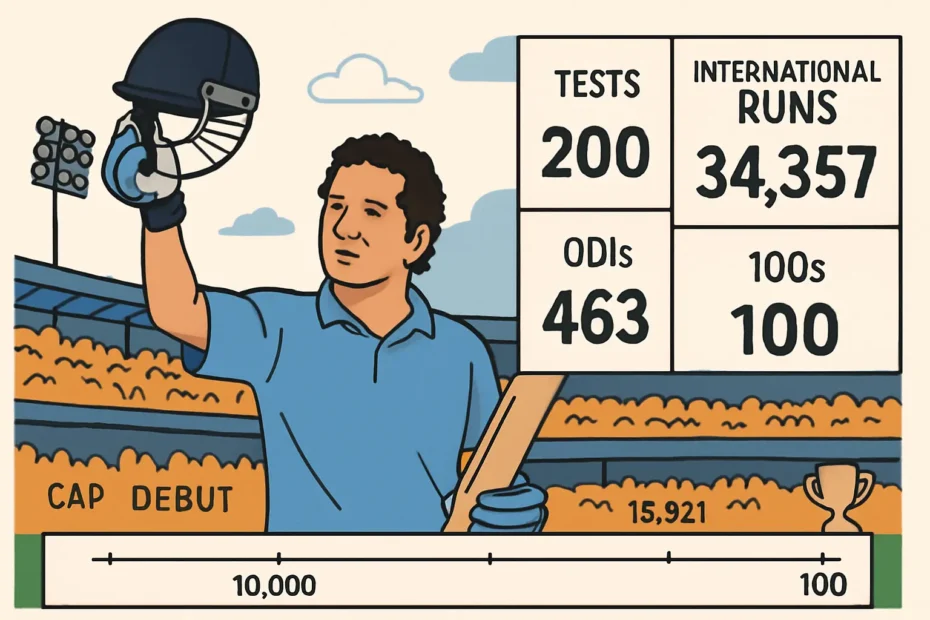
The record book didn’t chase Sachin Tendulkar. It grew around him, season after season, nation after nation, in spells of perfection that felt inevitable only because they were repeated so often. You can quantify it—runs, centuries, Man of the Match awards. But numbers tell only half the story. The other half lives in his methods: the silenced cover drive in Sydney to neutralize a trap, the lifted blade over extra cover at Sharjah against a howling wind and a great leg-spinner, the soft hands that made late movement look like a rumor. His records endure because they’re threaded through moments that shaped modern cricket.
Quick facts snapshot
- International matches: 664
- Total international runs: 34,357 (most in men’s international cricket)
- International centuries: 100 (51 Test, 49 ODI)
- Highest Test score: 248*
- Highest ODI score: 200* (first double hundred in men’s ODIs)
- ODI runs total: 18,426
- Test runs total: 15,921
- Man of the Match (ODI): 62 (record)
- Man of the Series (ODI): 15 (record)
- World Cup runs: 2,278 (record)
- World Cup centuries: 6
- International nineties: 28 (ODI 18, Test 10)
Why the Sachin Tendulkar records still matter
Longevity in cricket is not trivial. Opening in ODIs and batting in the top order in Tests means you face the hardest ball and the freshest bowlers, often on morning surfaces with a little green and in twilight with the ball skidding. Across continents, he kept showing up. It wasn’t just the volume; it was the completeness. Technique built in Mumbai schoolyards and hardened by tours to Australia, South Africa, England, and Pakistan allowed him to adapt to every era’s challenge—new balls that swung, white balls that stopped swinging early, reverse swing late at night, Kookaburra quirks, pitches that cracked and refused to bounce, spinners who hid the seam and tried to make him misread drift.
The feat of 100 international centuries is treated as a mountain. It’s also an endurance test: surviving form dips, injury cycles, tactical revolutions in ODI fielding restrictions, and bowlers attacking with data and discipline. The most Man of the Match awards in ODIs? It signals more than brilliance—it shows repeatability of match-winning influence. The World Cup numbers? Those came under the weight of a billion expectations and against attacks assembled from the best of every country.
ODI records: the Master Blaster in one-day cricket
ODI career snapshot
- Matches: 463
- Runs: 18,426
- Average: 44.83
- Strike rate: 86.23
- Hundreds: 49
- Fifties: 96
- Highest score: 200*
- Man of the Match: 62 (most in ODIs)
- Man of the Series: 15 (most in ODIs)
- Ducks: 20
- Nineties: 18 (most ODI nineties)
What made the ODI record stack unique
- Role redefinition at the top: Promoted up the order, Tendulkar recalibrated ODI powerplay batting for India. He attacked length early but with a technician’s eye—picking gaps behind point with the late cut, lifting over mid-off with a high-elbow check drive, and neutralizing swing by meeting the ball under the eye.
- Boundary control without slogging: The lofted extra-cover drive became an emblem of controlled aggression, especially against pace when third man and fine leg were up. He could strike at will without frantic risks.
- Range against spin: Off-spinners were worked with the paddle and the sweep; leg-spinners were treated with nimble feet and open-shoulder punches. Switch from footwork-first to late hands-only options made him hard to tie down in the middle overs.
- Scaling across eras: He mastered ODIs under different rule sets—fields spread wide, fields taken away, two balls, one ball; the principles stayed the same: shot selection by length, not by ego.
The first double hundred in men’s ODIs
The 200* in Gwalior against South Africa didn’t come as a slog. It was a timing masterclass. The key phases:
- The start: Traditional openers’ discipline—play straight, punish width. He didn’t overhit early, trusting placement.
- Middle overs: Expanded the arc—late cuts to beat third-man width, pick-ups off the hips behind square, a calculated surge at the fifth bowler.
- End overs: Read the angles of reverse swing, used the crease to carve the square boundaries, and protected strike intelligently. It was the culmination of years of opening mastery—elegance, fitness, and tempo control converging over fifty overs.
The Sharjah Desert Storm innings
Two innings defined a generation’s relationship with ODI cricket:
- The sandstorm game: A recalibrated chase after a literal storm reduced targets and visibility. Tendulkar’s response was calm violence—backing away to carve pace through and over cover, skipping down to meet spin at the pitch, and holding shape through every hit. He out-thought a champion attack by generating his own lengths and channels.
- The final: A follow-up hundred against the same opponents that felt like an encore and a coronation. The footwork to leg-spin was almost a study session: smaller steps, early pick-up off the hand, and then range—inside-out, over long-on, flat over extra cover.
ODI records that reflect consistency and pressure handling
- Most Man of the Match awards in ODIs: 62. It’s not simply about scoring big; it’s about scoring decisively—setting up wins or saving collapses, doing the right thing for the game state.
- Most Man of the Series in ODIs: 15. Sustained influence across multi-match stretches, not just one-off brilliance.
- ODI hundreds by opposition: Big hauls against Australia, Sri Lanka, Pakistan, South Africa, New Zealand—attacks with variety and pace. He accumulated, then dominated.
- ODI opening craft: As an opener, the bulk of his ODI runs came at a higher strike rate than his overall, testament to his control of the new ball phase.
Nineties and ducks in ODIs
- Nineties: 18. It reveals two truths—he lived in big territory often, and he rarely wasted starts. If anything, the tally points to a batter whose floor was remarkably high.
- Ducks: 20. It also reminds that opening comes with risk. First roads belong to fast bowlers. People remember his centuries; his willingness to absorb the worst conditions is what let him get there.
Test records: the classical edifice
Test career snapshot
- Matches: 200 (most in Tests)
- Runs: 15,921
- Average: 53.78
- Hundreds: 51
- Fifties: 68
- Highest score: 248*
- Home average: 52.67
- Away average: 54.74
The away-conditions supremacy
The away average being higher than the home average isn’t a quirk; it’s a characteristic. It speaks to a game designed to travel:
- In Australia: Back-foot punches through point and cover, then the restraint act in Sydney where he removed the cover drive—his favorite release—and scored big with on-side play and patience.
- In South Africa: The bat came down like a guillotine against steep bounce, soft hands muffling edges, and wrists rolling the ball down instead of across. The on-drive there carried a different menace—he hit on the rise without losing balance.
- In England: Held his shape late, met swing under the eyes, and lifted when bowlers overpitched searching for movement. The straight drive became a bowler’s nightmare; any error in length ended at the sightscreen.
- In New Zealand and the West Indies: Adapted to low bounce and slow surfaces by playing late and using singles to reset fields before attacking with sweeps and lofts.
Iconic Test performances that underline the records
- The Sydney masterclass: An innings where he banned the cover drive to deny an attack the line outside off. It was a public diagnosis of a plan and a surgical response. He turned bowlers into leg-side feeders of a plan he designed mid-contest.
- The Chennai heartbreak: A heroic chase crafted in humid, drifting conditions, all wrists and will, finishing in defeat but setting a standard for how to play a fourth-innings epic.
- The Perth pinnacle: Pace, bounce, hostility, and a teenager’s unflappable methods. He rode the bounce, never getting squared up by the short ball, and showed that a perfect technique shrinks a fast bowlers’ length by a foot.
Against Australia in Tests
He finished with a mountain of runs against them and a double-digit collection of centuries. More than raw tallies, it’s the range: from taking on elite pace in Perth to psychologically disarming a legendary leg-spinner in multiple venues, from batting through intervals to wearing out the new ball, the best team of his era met the most robust version of Tendulkar again and again.
Home vs away in detail
- Home: The patience game—sweeping spinners late, waiting for reverse swing to flatten. Numbers strong, but he often protected others by taking shine and pressure.
- Away: Expanded his triggers—small back-and-across with a still head, heel planted in time for good length, front shoulder closed to let the ball come. Away hundreds came in clusters because he solved conditions early in a series.
Captaincy in Tests
He captained in Tests across two phases, and by his own admission, enjoyed batting more than leading. The record reads modest—few wins, draws stacked, and several missed opportunities. Yet his mentorship of younger batters and close working with bowlers on lengths and field plans had a lasting, if less quantifiable, impact. Numbers don’t flatter this chapter; the dressing room legacy does.
World Cup records and ICC tournament footprint
Cricket World Cup
- Matches: 45
- Runs: 2,278 (most in World Cups)
- Average: above 50
- Strike rate: close to 90
- Hundreds: 6
- Fifties: 15
- Man of the Match awards: 9
- Twice topped the tournament run charts.
- Player of the Tournament once.
- Lifted the trophy once.
A World Cup is less about perfection and more about bravery under a spotlight that washes out everything else. Tendulkar’s World Cup supremacy has qualities you feel before you measure: the clarity of intent in powerplays, the self-denial on tricky surfaces, the selfless accelerations when partners needed the strike farmed. The uppercut over third man against Pakistan, the stepped hits against Australia, the on-drives that restored calm when chases tilted—these are part of sporting folklore.
Champions Trophy and global one-day events
An innings at Nairobi that tore through Australia with a contrarian plan—hit length through the line early to deny Warne his preferred pace—signaled his toolkit was equally deadly in knockout cricket. Across Champions Trophy editions, he was often India’s platform, turning group games into run factories and knockouts into statements.
Asia Cup
Tendulkar’s Asia Cup record shows solidity and reliability. He collected near a thousand runs in ODI Asia Cups, scored multiple hundreds, and often marked tournament starts with assurance knocks that stabilized India’s campaigns. The value-add wasn’t just runs; it was tempo control that allowed stroke-makers around him to play their game.
By opponent, by venue, by country
Versus Australia: the definitive rivalry
- Across formats: Twenty international hundreds against Australia underline a career-long duel where plan beat plan. He attacked spin with feet and used angles to rob pace bowlers of a full, threatening length.
- Desert Storm pair: Two historic knocks at Sharjah that turned a tri-series into a personal canvas.
- Test dominance: He scored heavily in their backyard, with landmark innings at Sydney and Perth, and at home against relentless spells from McGrath, Gillespie, and company.
Versus Pakistan: the finest edges
- The Chennai classic: A near-miracle chase, defined by touch shots and manipulation of in-out fields, was built on reading reverse swing and nullifying yorkers by meeting them late.
- Multan in command: A statement double-century that carried calm across days, refusing to chase tempo, forcing bowlers to blink first.
- World Cup pressure: The uppercut off Shoaib Akhtar remains one of the defining shots of the event, made possible by the tiniest delay in bat swing to ride pace over third man.
Versus England: technique under scrutiny
- Old Trafford rescue: A teenage master returned time to the crease with a hundred that saved a match and told the world a new cornerstone of Indian batting had arrived.
- Later tours: Hundreds that showed total balance—heads still, hands late, slips frustrated by the lack of hard hands.
Records in Australia
Australia gave him bounce and pace, and he responded with one of the most complete foreign records any subcontinental batter has produced. Multiple hundreds at the SCG, a masterpiece in Perth, and consistent run-making across venues built a body of work that’s considered among the strongest visiting records.
Records in England
Swing and seam prefer indecision; Tendulkar offered none. He left well, drove truer, and took singles in the ring to keep bowlers from bowling where they wanted. He left England with memorable hundreds and series aggregates that contributed to India’s evolving competitiveness.
Records at SCG
Sydney became a second home. That famous 200-plus without a single cover drive was a thesis on how to beat match-ups. He engineered an on-side scoring pattern so complete that bowlers ran out of ideas. Another hundred at the venue reinforced the bond—when the surface offered enough for bowlers, he still scored without fuss.
Records at Sharjah
Sharjah turned into a monogram. Aside from the Desert Storm, he routinely set up totals and chases, thriving on the smaller boundaries with fields up and bowlers desperate for breakthroughs that didn’t arrive. He read lengths earlier than most on those surfaces and crushed anything marginally short.
Records at Wankhede
The numbers are almost secondary. This was home, the close-in cacophony, the chant that sounded like song. His farewell at Wankhede became a national moment. The cricket remains simple there: soft feet, straight bat, wrists that made midwicket a runway. It closed the loop from prodigy to patron saint.
International centuries and milestones, unpacked
Hundreds by format
- Test centuries: 51
- ODI centuries: 49
- Total international centuries: 100
Why the hundred centuries are improbable
To get to 100, you must do fifty things twice: keep the body going; keep hunger fresh; keep reinventing patterns as bowlers solve you; find hundreds when they matter; and accept that some days you will play perfectly and still fall to a good ball. You must survive wrist injuries, back twinges, a tennis elbow, and the mental tax of being the center of every discussion. Tendulkar’s century record isn’t about four figures. It’s about the number of times he beat the game’s inevitabilities.
Nineties and near-misses
- International nineties: 28
- ODI nineties: 18
- Test nineties: 10
The psychology of the nineties has fascinated fans. In Tendulkar’s case, it was rarely panic. It was magnification: fielders in the right spots, bowlers trying miracles, and the reality that batting perfectly for hours increases the chances of a rare misread. The nineties tally is a signpost of how many times he got deep into innings.
Debut age and early milestones
As India’s youngest Test debutant, he entered dressing rooms filled with senior pros and immediate expectations. What stood out early was not the strokes everyone raves about, but the manner in which he absorbed short-ball plans without flinching and learned to convert fours to twos in a heartbeat—a fitness and awareness edge that bloomed later in ODIs.
Awards and honours
- Bharat Ratna
- Padma Vibhushan
- Padma Bhushan
- Padma Shri
- Rajiv Gandhi Khel Ratna
- Arjuna Award
- ICC Cricketer of the Year (Sir Garfield Sobers Trophy)
- Wisden Leading Cricketer recognitions
- Wisden Cricketers of the Year
- Laureus Sporting Moment (public vote)
- Numerous national sports and civilian honours
These honours recognize both output and meaning. His runs arrived at a time when Indian cricket shifted from hopeful to heavyweight. The awards are milestones of cultural change as much as personal excellence.
Niche and micro-stats that complete the picture
- Most international runs: 34,357
- Most international centuries: 100
- Most ODI runs: 18,426
- Most ODI Man of the Match awards: 62
- Most ODI Man of the Series awards: 15
- Most World Cup runs: 2,278
- Most international matches: 664
- Most Test matches: 200
- ODI strike rate: 86.23
- Test average: 53.78
- International nineties: 28
- ODI ducks: 20
Captaincy record
- Tests as captain: 25 (wins 4, losses 9, draws 12)
- ODIs as captain: 73 (wins 23, losses 43, others remainder)
He is a canonical case of a great player who did not need the armband to lead. His on-field suggestions, constant conversation with spinners about pace and length, and instinct for field changes at short leg made him a tactician even without the label.
Sachin Tendulkar vs opponent and tournament: targeted highlights
Against Australia (combined formats)
- International hundreds: 20
- ODI hundreds against Australia: 9
- Test hundreds against Australia: 11
His full-blooded battles with McGrath, Warne, Lee, and Gillespie built a narrative that stretched across tours. As a purely sporting rival, Australia extracted his best cricket repeatedly.
World Cup dominance summarized
- Runs: 2,278
- Hundreds: 6
- Man of the Match awards: 9
- Player of the Tournament once; top run-scorer twice
Beyond the sums, think of tactical mastery. He often opened and made that first powerplay an advantage: rapid 30s, then the cruise to a hundred if wickets allowed. Later in tournaments, he played the consolidator, leaving the high-risk pushes to younger partners while remaining available to recalibrate if wickets fell.
Asia Cup contribution
He remains among the leading run-getters in the tournament’s ODI history, with multiple hundreds and a rich collection of fifties. His batting often provided stable starts that let finishers bloom.
Champions Trophy imprint
Memorable knocks, including a headline performance in Nairobi, showed he could take his ODI template to knockout pressure and make it sharper. He repeatedly found ways to attack leg-spin with minimal risk and maximum field manipulation.
Comparisons and “who broke” what
- ODI centuries: Virat Kohli surpassed Tendulkar’s ODI century tally. Tendulkar’s mark stood as a summit for a generation.
- International centuries: Tendulkar remains on top with 100.
- ODI runs: Tendulkar still holds the record.
- World Cup single-edition runs: Tendulkar’s once-immense benchmark was overtaken in a later edition. He still holds the overall World Cup aggregate record.
- First ODI double hundred: Tendulkar remains the pioneer; others later expanded the club, with Rohit Sharma famously owning multiple double hundreds.
Can anyone touch 34,357 international runs?
Volume plus quality is the rarest combination in batting. It demands iron fitness, a secure spot in both formats for a decade and a half and more, and a near-absence of prolonged slumps. Modern scheduling creates opportunities, but rest cycles, format specialization, and injury management complicate accumulation. Tendulkar’s aggregate resides at the intersection of endurance, obsession, and skill in an era that demanded them all.
Technique notes: why the records kept coming
- Alignment and head position: He aligned early, head over off stump, which let him judge late movement. That alignment is why the straight drive looked like a textbook illustration rather than a risky play.
- Hands and timing: Very late hands against pace, which let him use the bowler’s speed. Against spin, quiet hands with crisp feet—transfer weight later to play inside the line or forward with soft hands to kill turn.
- Triggers: Small back-and-across to get off stump covered; no big pre-movements that could be trapped by a change in length.
- Shot selections by condition: In Australia, he rode the bounce square; in England, he drove only within his bubble; at home, he swept more and defended less with hard hands.
- Mental framing: Treat every delivery as independent. You saw it in Sydney when he shelved the cover drive entirely, turning a strength into a bait he refused to bite. That’s process over compulsion, the apex of batting control.
Era context that strengthens his case
- Bowling quality: Across his career, he faced era-defining greats—Ambrose, Walsh, Waqar, Wasim, Donald, Pollock, McGrath, Warne, Murali, Kumble, Steyn in later phases, and Shoaib Akhtar at top speed. The aggregate built against this roster adds weight.
- Fielding restrictions and balls: He adapted through multiple ODI rule regimes and ball conditions, including the one-ball era where reverse swing came into play late and the two-ball world where slogs could be planned. In Tests, he thrived across different ball manufacturers and surface behaviors.
Curated tables for quick reference
Career totals (international)
| Format | Matches | Runs | Avg | SR | 100s | 50s | HS |
|---|---|---|---|---|---|---|---|
| Tests | 200 | 15,921 | 53.78 | — | 51 | 68 | 248* |
| ODIs | 463 | 18,426 | 44.83 | 86.23 | 49 | 96 | 200* |
| T20Is | 1 | 10 | 10.00 | — | 0 | 0 | 10 |
| Totals | 664 | 34,357 | — | — | 100 | 164 | — |
ODI records at a glance
| Category | Number | Note |
|---|---|---|
| Runs | 18,426 | Most ODI runs |
| Hundreds | 49 | Second-most ODI hundreds |
| Fifties | 96 | Among the highest |
| Highest score | 200* | First ODI double hundred (men’s) |
| Man of the Match | 62 | Most in ODIs |
| Man of the Series | 15 | Most in ODIs |
| Nineties | 18 | Most in ODIs |
| Ducks | 20 | Opening risk reflected |
World Cup snapshot
| Category | Number | Note |
|---|---|---|
| Matches | 45 | Longevity across editions |
| Runs | 2,278 | Most in World Cups |
| Hundreds | 6 | Among the most |
| Fifties | 15 | Consistent high-level outputs |
| Man of the Match | 9 | Tournament-impact figure |
| Player of the Tournament | 1 | Crown ed once |
| Times top run-scorer | 2 | Led two editions |
| Titles | 1 | Lifted the trophy |
Test home vs away
| Split | Runs | Avg | 100s |
|---|---|---|---|
| Home | 7,216 | 52.67 | — |
| Away | 8,705 | 54.74 | — |
Note: Away average higher than home—rare among high-volume batters.
Signature records and achievements
- Most international runs in men’s cricket: 34,357
- Most Test matches: 200
- Most international centuries: 100
- Most ODI runs: 18,426
- First double hundred in men’s ODIs (200*)
- Most Man of the Match awards in ODIs: 62
- Most Man of the Series awards in ODIs: 15
- Most runs in Cricket World Cups: 2,278
- ODI nineties: 18 (record)
- International nineties: 28
- ODI hundreds against Australia: 9
- International hundreds against Australia: 20
- Highest Test score: 248* (away)
By year without the years: phases of evolution
- The prodigy phase: Early doors, he proved he could survive and then thrive in away conditions that break many seasoned players. The Perth hundred announced him to fast bowlers as a peer rather than prey.
- The ODI redefinition: Promotion to opener unlocked a richer ODI toolkit. India discovered a template—attack early with control, then stretch the middle overs so finishers didn’t need miracles.
- The reinvention years: Injury interruptions pushed him toward a more compact game. He emphasized singles, let the game come to him, and transformed into a high-average accumulator without shedding the big strokes.
- The veteran’s mastery: Later, he returned to power more selectively—picking overs to attack, partners to shield, and bowlers to wear down. The 200* cemented a late-career peak uncorked by wisdom.
Tactical signatures in pressure matches
- Removing shots to control bowlers: In Sydney, shelving the cover drive starved bowlers of width as a trap. The on-side earnings rose, and frustration forced errors.
- Attacking leg-spin with the inside-out: He opened the front shoulder just enough to create a new channel over extra cover, a killer option once he got to the pitch.
- Riding the bouncer: As a teenager and beyond, he preferred to ride bounce with the head still and the bat high, turning hostile spells into scoring sorties through point and midwicket.
- Reverse swing management: He played late, trusted straight bats to full balls, and avoided falling across when tailing deliveries came in.
Frequently sought answers
- How many international centuries did Sachin Tendulkar score?
100. - What is Sachin Tendulkar’s total international runs?
34,357. - How many ODI centuries does Sachin Tendulkar have?
49. - What is Sachin Tendulkar’s highest ODI and Test score?
ODI: 200*. Test: 248*. - How many Man of the Match awards did he win in ODIs?
62. - How many times was he out in the nineties in international cricket?
28. - Which country did he score the most international runs against?
Australia. - How many Cricket World Cup runs and centuries does he have?
2,278 runs and 6 centuries. - When did he score the first ODI double hundred?
In Gwalior against South Africa.
Man of the Match and Man of the Series: why these two records are priceless
Runs don’t always equal wins. Tendulkar’s sixty-two Man of the Match awards in ODIs mean his output had a strong correlation with results. He wasn’t padding on dead tracks after the game drifted; he was framing the direction of the game. Fifteen Man of the Series awards amplify the same message—he was not a one-day wonder in tournaments; he owned multi-match arcs, adjusting to opponents’ plans as series unfolded.
Strike rate and tempo
His ODI strike rate sits over 86, an elite number from a batter who played across changing rules and ball conditions. That rate wasn’t the product of heaves. It came from precision—finding gaps repeatedly, turning strikes over with near-machine reliability, and selecting the right overs for controlled aggression. In Tests, his average north of 50 paired with a scoring rate brisk enough to keep games moving, without exposing his wicket to ego traps.
What remains untouchable—and what might be surpassed
- Likely to stand long: 34,357 international runs; 100 international centuries; 664 international matches; 200 Tests.
- Already surpassed or under threat: ODI centuries surpassed by Virat Kohli; single-edition World Cup runs surpassed by Virat Kohli; some “fastest to” milestones taken by batters of the modern run-glut era.
- Context: Even when individual marks fall, the combined suite—runs, matches, centuries, influence in World Cups, Desert Storm mythology—forms an ecosystem of greatness that is hard to recreate.
Sachin Tendulkar vs Virat Kohli vs Rohit Sharma: the clean view
- Tendulkar vs Kohli: Kohli has more ODI hundreds; Tendulkar still owns total international runs and total centuries. Kohli’s chase mastery rewrote ODI finishing. Tendulkar’s longevity and away-Test excellence remain models.
- Tendulkar vs Rohit Sharma: Rohit has multiple ODI double hundreds, expanding the frontier Tendulkar opened. Tendulkar’s accumulation over decades across formats still sets the career scale.
- Who has more centuries, Sachin or Kohli?
Internationally, Tendulkar. In ODIs, Kohli.
Behind the numbers: what the best bowlers said without saying
Faced with two new balls or one old one, Tendulkar found the seam late enough to reduce miracles to mere movement. Great fast bowlers tried to go fuller, hoping for LBW; he drove. They went shorter, hoping to push him back; he punched. Leg-spinners lured him wide; he used his feet to get to the pitch and turn their turn into his arc. Off-spinners drifted at him; he knocked them behind square and forced captains to rearrange. The hidden record is the number of plans he outlived.
Copy-ready record tables you can save
International tallies by format (high-level)
| Format | Matches | Runs | Avg | SR | 100s | 50s |
|---|---|---|---|---|---|---|
| Tests | 200 | 15,921 | 53.78 | — | 51 | 68 |
| ODIs | 463 | 18,426 | 44.83 | 86.23 | 49 | 96 |
| T20Is | 1 | 10 | 10.00 | — | 0 | 0 |
| Totals | 664 | 34,357 | — | — | 100 | 164 |
World Cup ledger
| Metric | Value |
|---|---|
| Matches | 45 |
| Runs | 2,278 |
| Average | 56.95 |
| Strike rate | 88.98 |
| Hundreds | 6 |
| Fifties | 15 |
| Man of the Match | 9 |
Signature milestones checklist
| Milestone | Status |
|---|---|
| International runs leader | Yes |
| International centuries leader | Yes |
| Most ODI runs | Yes |
| First ODI 200* | Yes |
| Most ODI MoM | Yes |
| Most ODI MoS | Yes |
| Most World Cup runs | Yes |
| Most Test matches | Yes |
Awards list
- Bharat Ratna
- Padma Vibhushan
- Padma Bhushan
- Padma Shri
- Rajiv Gandhi Khel Ratna
- Arjuna Award
- ICC Cricketer of the Year (Sir Garfield Sobers Trophy)
- Wisden Leading Cricketer recognitions
- Wisden Cricketers of the Year
- Laureus Sporting Moment (public vote)
A last word on the Master Blaster records
In the end, the data falls in line behind something larger. Tendulkar’s career is not a statistical outlier; it’s a living exhibit of what batting looks like when obsession meets order. The straight drive that cut air into two equal halves is a museum piece now, but the craft behind it is the real legacy: a perfectly still head, an index finger flex on the handle, an elbow that rose like sunrise and fell like verdict. His records stand because he made that form repeatable under different skies and different balls against different ideas of how to get him out.
For anyone chasing, the challenge is as much spiritual as it is numerical. Stay fit long enough. Stay curious long enough. Stay humble enough to lose a favorite shot for a day if it wins a game. The mountain of numbers has a name, and that name belongs to a batter who treated each delivery as a blank page and still ended up writing the longest chapter.
