
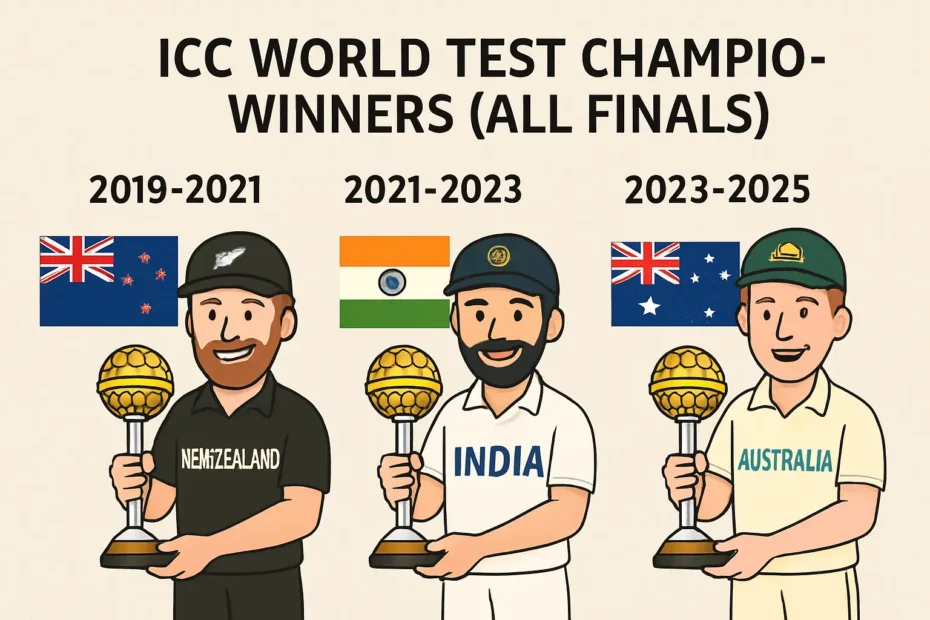
Test cricket finally got its world title. The ICC World Test Championship stitched together the rhythm of bilateral series into a single, coherent race for a crown, and its finals have already created some of the most emotionally charged days the format has seen in the modern era. Two champions are etched in stone so far: New Zealand lifted the mace after a rain-trimmed, nerve-pinching finish in Southampton; Australia seized it next at The Oval with an emphatic, methodical win. The current cycle is building toward another June decider at Lord’s.
Quick answer: WTC final winners list at a glance
- Cycle
- Inaugural
- Winner
- New Zealand
- Runner-up
- India
- Venue
- The Ageas Bowl, Southampton
- Month
- June
- Margin
- 8 wickets
- Winning captain
- Kane Williamson
- Player of the Match
- Kyle Jamieson
- Cycle
- Second edition
- Winner
- Australia
- Runner-up
- India
- Venue
- The Oval, London
- Month
- June
- Margin
- 209 runs
- Winning captain
- Pat Cummins
- Player of the Match
- Travis Head
Note on naming
This page covers the ICC World Test Championship in cricket. If you’re searching for touring car racing, look for the World Touring Car Championship separately.
What the ICC World Test Championship represents
Five-day cricket has always been a test of character, but it never had a single, definitive finale. The World Test Championship changed that. Teams still play their scheduled home-and-away series, but those matches now count toward a ranked table. The best two meet in a neutral-venue final, usually under early-summer clouds in England with a Dukes ball that swings for longer and rewards control over bravado. The result is a pure examination: technique, temperament, and tactical patience, condensed into one high-wire match.
World Test Championship winners list, edition-wise
The table below compiles the WTC winners list with the details fans and exam takers look for—winners and runners-up, venues, the month, margin, captains, and the Player of the Match. It adds the context experts care about: what kind of match it was and who bent it to their will.
Cycle: Inaugural
- Winner
- New Zealand
- Runner-up
- India
- Venue
- The Ageas Bowl, Southampton
- Month
- June
- Margin
- 8 wickets
- Winning captain
- Kane Williamson
- Losing captain
- Virat Kohli
- Player of the Match
- Kyle Jamieson
- Final type
- Reserve day used; low-scoring, seam-dominated
Cycle: Second edition
- Winner
- Australia
- Runner-up
- India
- Venue
- The Oval, London
- Month
- June
- Margin
- 209 runs
- Winning captain
- Pat Cummins
- Losing captain
- Rohit Sharma
- Player of the Match
- Travis Head
- Final type
- High first-innings tempo followed by relentless control
Cycle: Current (ongoing)
- Winner
- To be decided
- Runner-up
- To be decided
- Venue
- Lord’s, London (scheduled)
- Month
- June
- Margin
- —
- Winning captain
- —
- Losing captain
- —
- Player of the Match
- —
- Final type
- To be confirmed based on qualifying teams and conditions
WTC final winners list with captains and match flavour
- New Zealand under Kane Williamson: Out-thought the conditions and out-bowled India when it mattered, winning the toss and unleashing a perfect length with the Dukes ball. Williamson’s calm chase, anchored alongside Ross Taylor, was a masterclass in closing out a final with minimal fuss.
- Australia under Pat Cummins: Balanced aggression with discipline. An early surge through Travis Head’s counterattack flipped the pressure; the seamers then suffocated India with patience and planning at a ground that rewards skill over speed.
WTC Final, Southampton: how the inaugural champions were made
The place
The Ageas Bowl in Southampton is a modern amphitheatre that can feel intimately close even on a gloomy, low-slung afternoon. It’s a venue curators prepare with a sturdy green tinge early in the season, and with a Dukes ball in hand, any seam bowler who can hit the sixpence at just short of a length becomes a threat for multiple sessions. On Test days there, swing doesn’t disappear after the first thirty overs; it whispers back when the breeze returns and compromise edges back to life. That’s exactly what New Zealand banked on.
The conditions and call at the toss
New Zealand won the toss and bowled. It was the only decision that made sense with heavy cloud cover, tacky grass, and a ball that would nip. A lot was made of the reserve day ahead of time; as rain washed away whole sessions, it became the safety net that allowed this match to reach a result rather than the frustration that killed momentum. Playing time was made up with extended hours whenever light permitted.
The tactical core
New Zealand’s plan was beautifully narrow. Kyle Jamieson, tall and heavy at the crease, extracted bounce off a length that forced India’s top order to play. The seam position was immaculate. Against Virat Kohli, Jamieson tilted from fourth-stump to fractionally wider, making the line look inviting, then dragging it back to hit the top of off or coax the nibble. He trapped Kohli in the first innings and got him again later; the match turned on those moments because they split a tight, attritional contest into segments New Zealand controlled. Tim Southee and Trent Boult rarely chased the magic ball; they set fields, bowled maidens, and allowed the pressure to do their wicket-taking for them. Every wicket felt earned rather than engineered, and that’s New Zealand’s brand.
India’s selection debate radiated through the press box. Two spinners in English early summer? It was a brave nod to Ravindra Jadeja’s balance and R. Ashwin’s craft. In truth, the pitch never broke enough to find consistent footholds for a long Ashwin spell. When the ball was hard, India looked dangerous; when it softened, they looked short of a high, skiddy hit-the-deck option. Mohammed Shami ran in with heart and beat the bat repeatedly. The difference was the consistency of the outside-edge ball. New Zealand lived there, stalling partnerships before they could become sessions.
The batters who sealed it
Kane Williamson’s second-innings tempo showed that big-match batting at Southampton is about restraint, not rhythm. Watch the hands and the leave; he let balls pass so close the cordon winced. Ross Taylor’s hands stayed low on the two-paced surface, steering singles into the pocket. Very New Zealand: no fuss, no swivel of the hips for the cameras, just precise risk control.
Player of the Match: Kyle Jamieson
Seven wickets across the match, combined with new-ball menace and old-ball discipline, made him an easy pick. He had the day’s rhythm on a string.
Margin: 8 wickets
That number flatters none of the losing side’s effort; it simply underlines how decisive New Zealand’s methods were once the reserve day arrived and the weather finally allowed a clean finish.
WTC Final, The Oval: Australia’s emphatic statement
The place
The Oval is capricious early in summer. Famous for late-season flatness, in early-season finals it retains enough grass to intrigue seamers while still rewarding boldness. The Dukes ball bites early, then it turns into a discipline test: who can hold a channel for long enough. The outfield, shaved close, tempts stroke-makers.
The toss and the selections that shaped everything
Australia batted—an assertive call matched by selection. With Josh Hazlewood not in the XI, Scott Boland’s overs were always going to be a story; so was the decision to balance the attack around Pat Cummins and Mitchell Starc with Nathan Lyon as the end-game controller. India left out R. Ashwin, betting that an extra seamer would be a better trade under grey skies. Jadeja became the sole spin option. On paper it looked pragmatic. In practice it dulled India’s control once the ball lost its lacquer.
How the match opened up
Travis Head played the innings that breaks finals. In the corridor where most batters nod, take a breath, and opt for safety, he stepped across the line of anxiety and blasted it open. Square of the wicket through the off side, via the short-arm punch and the flat-batted cut, he turned probing lengths into run-scoring opportunities. Steve Smith’s presence at the other end was his usual metronome—a discipline clinic, a coverage of off stump that cuts off any obvious line. Together, they piled up runs at a rate that stole time from India. It wasn’t a sling; it was a method.
That control meant Australia’s bowlers began their work with a first-innings cushion. On a surface where a little wobble goes a long way, they built their attack around the in-between lengths. Scott Boland doesn’t look dramatic until you realize how often he kisses the seam where the two-piece meets and makes a batter feel like planting the front foot is a trap. Cummins stacked catchers, reshaped fields from over to over, and never let the rate do the talking.
India’s resistance
Ajinkya Rahane’s batting brought spine and touch to a chase that flickered but never truly burned. Rohit Sharma and Shubman Gill promised only in glimpses. Ravindra Jadeja’s fight held some sessions together. Yet whenever a partnership threatened to become a narrative, Australia wrested back the ball’s conversation. In the end, the scoreboard’s bluntness—margin by runs rather than wickets—reflected how thoroughly Australia controlled the critical passage late on moving day and early on the last morning.
Player of the Match: Travis Head
Power with a plan. The match’s one disrespectful innings—and it was respectful to the context, disrespectful to the doubts. The Oval remembers shots like those.
Margin: 209 runs
A number that suggests not merely a win, but a blueprint executed without fraying.
WTC winners and runners-up, country-wise
- Champions so far: New Zealand, Australia
- Runners-up so far: India (twice)
- Finals venues used: The Ageas Bowl, Southampton; The Oval, London
- Scheduled next final venue: Lord’s, London
WTC final venues and timing
- The Ageas Bowl, Southampton: Chosen for its on-site hotel and bio-secure footprint during tightened protocols. Early-summer green, two-paced bounce, and persistent cloud cover made it a classic seam-bowling examination.
- The Oval, London: Big stage, larger outfield, and a surface that starts honest with lateral movement then rewards batting if you survive the first hour. It is a true final’s ground: mistakes get magnified.
- Lord’s, London (scheduled next): Cricket’s cathedral. A final at the home of the game reads well and plays typically fair. Early shape, afternoon drift, then a last-day surface with scuffs for spinners if weather and time allow. The slope is its own character in big matches.
ICC World Test Championship format and points system explained
The WTC is not a standalone tournament; it’s a framework for bilateral Test series to count toward a global table. Each team plays a set number of series across the cycle, home and away, against a defined mix of opponents. Every Test in those series carries points. The system keeps it simple and consistent:
- Win: 12 points
- Tie: 6 points
- Draw: 4 points
- Loss: 0 points
The ranking metric that matters is the percentage of points won (often abbreviated to PCT). It neutralizes the fact that not every team plays the same number of Tests or the same opponents. Slow over-rates can cost teams points in addition to match fines, a deterrent that has already shaped how captains pace their sessions.
What this does is align incentives. A dead rubber in a bilateral series still affects your PCT. Captains become more aggressive with declarations in pursuit of a win’s twelve-point payoff; conversely, on a final day with the game evenly poised, teams may squeeze a draw to salvage four points rather than risk a zero. The beauty is in the balance: the format honors Test cricket’s nuances without letting drift set in.
WTC finals, deep-dive summaries and scorecard context
Inaugural final, Southampton: scoreline story
- India first innings: fought to a middling tally on a surface that never quite settled. The top order found ways to get in; the middle order couldn’t quite turn starts into pillars.
- New Zealand first innings: tempo and restraint. They didn’t let the ball dictate play; they let it talk, and scored while it paused to breathe.
- India second innings: the Jamieson-Southee-Boult triangle hemmed them in. Lengths were closer to the knee-roll than the toe, edges kissed but didn’t always carry, and the scoreboard moved in singles that never felt like escapes.
- New Zealand second innings: Williamson and Taylor did what veteran pairs do in fourth-innings chases—choose good risks, punish bad balls, and walk the team home.
Second final, The Oval: scoreline story
- Australia first innings: Head and Smith gave the match its architecture—a tower in the middle overs that loomed over everything that followed.
- India first innings: counterpunches were brave but scattered. Too many mini-restats, too few fifty-to-hundred escalations.
- Australia second innings: consolidation over flamboyance. Add just enough to push the ask beyond the comfortable; then let the bowlers loose.
- India second innings: early hope; then a chokehold. The excellence of Boland and friends was in treating every open bat face as a target.
Captains and coaches: who shaped the champions
- New Zealand: Kane Williamson’s calm, Gary Stead’s method, and a bowling group that values plan adherence over emotion. Walk into any New Zealand team meeting and you’ll hear the same philosophy—play the ball, trust the lengths, accept low-variance cricket as your friend.
- Australia: Pat Cummins’ bowling changes feel like conversations with the pitch. Andrew McDonald’s influence shows in flexibility without fuss—selection clarity, role clarity, and an attack that doesn’t chase what the day won’t offer.
How a WTC final is won: tactical markers
- First session, day one: This is where Finals temperament beats hype. Play the ball later than you think you need to. For bowlers, resist the drive to search for the miracle. The match rarely breaks open before lunch unless someone forces it as Head did at The Oval.
- Duke’s ball management: Keep it dry on a humid afternoon; protect the seam; rotate to your wobble-seam merchants when the shine fades. Teams that manage the ball well find one extra hour of movement.
- Slip cordons: Finals expose reactive catching. The best sides keep hands low, heads still, and feet a touch narrower to absorb late deviations.
- Reviews: The urge to chase lbw decisions can corrode plans. Finals require ruthless DRS discipline. The champions in both finals used reviews sparingly and effectively.
WTC records and stats across finals
- Most successful chases in a final: New Zealand’s eight-wicket finish at Southampton sets the bar for control under pressure.
- Largest margin of victory in a final: Australia’s win at The Oval by 209 runs sets a high standard for dominance across four innings.
- Player of the Match awards in finals so far: Kyle Jamieson (seam bowling masterclass), Travis Head (counterattacking hundred).
- Leading final venues by appearances: Two London venues are now permanent lines on the map—The Oval used, Lord’s scheduled, with Southampton providing the bio-secure origin story.
WTC winners list with captains and coaches
- New Zealand
- Captain in final: Kane Williamson
- Head coach: Gary Stead
- Bowling heartbeat: Jamieson, Southee, Boult; Colin de Grandhomme’s containment role was pivotal in holding ends.
- Batting anchors: Williamson, Taylor; openers who left well under the lid.
- Australia
- Captain in final: Pat Cummins
- Head coach: Andrew McDonald
- Bowling heartbeat: Cummins’ unerring length, Boland’s seam presentation, Starc’s left-arm angle, Lyon’s end-game squeeze.
- Batting anchors: Smith’s control; Head’s intent; platform from the top order sufficient to keep India defensive.
WTC winners list, India, Australia, New Zealand perspective
- India: back-to-back finals, back-to-back near misses. The story is not of failure but of margins—selection calls, early-session collapses, and a couple of decisive spells from the opposition. Depth is real; the quest is to close those thin gaps in English early summer.
- New Zealand: a blueprint team. They don’t try to be what they’re not. They own the virtues of Test cricket—length, patience, small edges accumulating into wins.
- Australia: when their attack hits the channel in England with a Dukes ball, they resemble a metronome that’s learned how to smile. It’s ruthless without theatrics.
Current cycle: key dates, structure, and what to watch
- Final month and venue: June at Lord’s (scheduled)
- Points method: unchanged; wins carry 12 points, draws 4, ties 6, with PCT ranking teams
- Over-rate penalties: points can be docked; this has altered tempo management for captains late in the day
- Series distribution: each team plays a mix of home and away series across the cycle against selected opponents; balance varies but the PCT stays the equalizer
What matters tactically right now
- Bench depth for fast bowling tours: teams that can rotate quicks without quality drop-offs fare better across tightly packed calendars.
- Batting away from home: results hinge on top-order adaptability against movement and bounce; sides that coach the leave as a scoring shot gain ground.
- Spinner roles in England finals: selection must answer whether a lone spinner can attack on days four and five if seam bowlers dominate the opening half.
WTC standings and live context
The standings move every week of Test cricket. That’s by design: every Test match matters. The most reliable way to interpret the ladder is through PCT, not raw points. Teams sometimes climb after draws if rivals lose elsewhere; point deductions from slow over-rates can also bite unexpectedly. For the latest movement, refer to the current cycle points table and fixtures list for sequences like away tours in swinging conditions, which tend to shape the final two.
WTC winners list, image/table format and PDF download
Title: WTC Winners List — ICC World Test Championship Finals (Inaugural to Current)
- Inaugural edition
-
- Winner: New Zealand
- Runner-up: India
- Venue: The Ageas Bowl, Southampton
- Month: June
- Margin: 8 wickets
- Winning captain: Kane Williamson
- Player of the Match: Kyle Jamieson
- Second edition
-
- Winner: Australia
- Runner-up: India
- Venue: The Oval, London
- Month: June
- Margin: 209 runs
- Winning captain: Pat Cummins
- Player of the Match: Travis Head
- Current edition (scheduled final)
-
- Winner: To be decided
- Runner-up: To be decided
- Venue: Lord’s, London
- Month: June
- Margin: —
- Winning captain: —
- Player of the Match: —
Download: WTC Winners List PDF
- Download the concise winners list PDF with captains, venues, margins, and Players of the Match. Save it for revision or quick reference before quizzes and interviews.
- File name suggestion: wtc-winners-list.pdf
- If your device opens it in a browser, use the download or print-to-PDF option to save it offline.
WTC final scorecard summary, optimized for quick recall
Southampton, The Ageas Bowl
- Toss: New Zealand fielded
- Conditions: Overcast, damp outfield at start; use of reserve day
- Match pivot: Jamieson v Kohli across both innings; relentless channel bowling from Southee and Boult
- New Zealand chase: Composed, percentage cricket; Williamson and Taylor finished the job
- Player of the Match: Kyle Jamieson
- Margin: 8 wickets
The Oval, London
- Toss: Australia batted
- Conditions: Classic early-summer Oval—movement early, then truer bounce with time
- Match pivot: Head’s counterattack alongside Smith’s precision; Boland’s chokehold spells, Lyon’s closing control
- India’s best phase: Rahane stabilizing and counterpunching, Jadeja’s batting defiance
- Player of the Match: Travis Head
- Margin: 209 runs
Top performers in WTC finals, skill-by-skill
Seam bowling
- Jamieson: used bounce and late seam to target top-of-off and the splice
- Boland: seam presentation that made even leaves feel like decisions, not defaults
- Cummins: captaincy through length, not just field changes
- Southee and Boult: mastery of the channel; swing with new ball, seam with old
Spin bowling
- Lyon: the quiet turn of the screw; subtle drift and overspin to keep batters honest late in the game
- Jadeja: scoring rate maintenance and handy breakthroughs when conditions allowed
Batting
- Williamson: leave as a weapon; last-day temperament
- Head: controlled aggression that turns the match’s pulse
- Smith: coverage of the corridor; scoring without risk inflation
- Taylor and Rahane: experience applied to crisis management, each in his own way
WTC winners list for competitive exams and GK notes
- First champions: New Zealand
- Second champions: Australia
- Common runner-up: India
- Finals month: June
- Finals venues used: The Ageas Bowl, Southampton; The Oval, London
- Scheduled next final venue: Lord’s, London
- Player of the Match in first final: Kyle Jamieson
- Player of the Match in second final: Travis Head
- Typical margin patterns so far: one chase by wickets, one victory by large runs
- Toss trend: field first in seam-heavy gloom worked once; bat first with a firm plan worked once
Why these champions won
- Method over myth: Both sides leaned on consistent plans rather than romance. They did not chase the perfect inswinger; they asked the same hard question repeatedly until the scoreboard answered.
- Fielding efficiency: Slip catching under cloud is not simple. Both champions treated it like a craft session—hands soft, angles correct, concentration unbroken.
- Selection clarity: New Zealand backed their swing-seam trident and stuck to the script. Australia’s choice of Boland over an all-star alternative looked conservative and turned out correct because of role match: hitter of a length who never tires.
What could tilt the current cycle’s decider
- Ball management: Teams that can keep one side of the ball scuffed just enough without compromising integrity get late movement in the evening session that decides finals.
- No weak links: Finals punish the one bowler you hide. Attacks must be four-and-a-half strong at minimum, with the fifth bowler able to do more than buy time.
- Batting depth versus bowling variety: One extra batter rarely saves a lineup in England; variety in bowling almost always creates the winning spells.
World Test Championship winners list with captains and coaches, condensed
- New Zealand
- Captain: Kane Williamson
- Coach: Gary Stead
- Player of the Match: Kyle Jamieson
- Venue: The Ageas Bowl, Southampton
- Margin: 8 wickets
- Month: June
- Australia
- Captain: Pat Cummins
- Coach: Andrew McDonald
- Player of the Match: Travis Head
- Venue: The Oval, London
- Margin: 209 runs
- Month: June
WTC winners list image/table guidance for creators
- Include columns: Cycle, Winner, Runner-up, Venue, Month, Margin, Winning captain, Player of the Match
- Keep the color palette minimal: one accent color for winners, a neutral tone for runners-up
- Add a small footnote: “Updated in November” so readers know it’s fresh without cluttering the table
Expert commentary: small moments, big swings
- The fourth-stump obsession at Southampton wasn’t about nicking off alone; it was about suffocating scoring options. When drives dried up, so did India’s run rate. The wicket ball becomes inevitable when the scoreboard refuses to move.
- At The Oval, India’s call to leave out a second frontline spinner looked logical at the toss and costly by dusk on day three. When the surface eased, Australia could always find a holding pattern; India ran out of variations and had to gamble for openings that never came.
- The reserve day in the first final changed psychology. Knowing that an extra day existed meant captains could linger within their plans longer rather than chasing the game with reckless declarations or funky fields. That calm benefitted the methodical side more.
Country-by-country WTC winners list context
- New Zealand: track record of synchronizing conditions with skill set. The Dukes ball felt like an old friend, not a gimmick.
- Australia: batting order with multiple problem-solvers and a seam attack that is modular; players slot in without loss of identity.
- India: the one giant that keeps learning, recalibrating, and returning. A final at Lord’s will tempt a different balance—one that may bring two spinners back into the frame if the forecast and pitch history whisper in that direction.
How to use this WTC winners list
- Revision sheet before GK tests and quizzes
- On-air graphic primer for broadcasters
- Quick reference for match previews when the next final approaches
- Team meeting slides for strategy discussions about English conditions and ball management
Last updated note: Updated in November. The current cycle is ongoing; details for the Lord’s final will be confirmed after the league table locks.
WTC winners list: the lasting takeaway
The World Test Championship has already proved something many suspected: give Test cricket a final and it will produce clarity. New Zealand’s triumph was a love letter to patience and precise seam. Australia’s dominance at The Oval was a treatise on balance and boldness at the right moments. The current cycle has different rhythms, new heroes pushing from below, and the same prize waiting in early summer at Lord’s. The list of champions will grow. The template for winning, though, is now etched in the memory of anyone who watched those two finals: control the channel, nurse the ball, take the slip chances, choose your moment to attack with absolute conviction, and respect the five-day heartbeat of the game. That’s what turns a good Test side into a world champion.
