
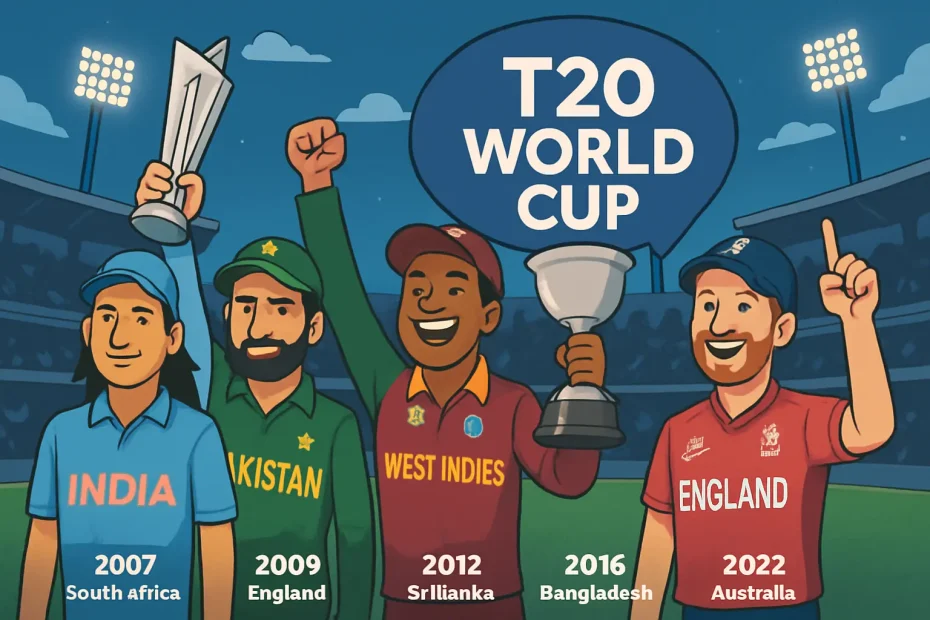
There’s a particular electricity that the T20 World Cup delivers: a crackle that starts in the first over, ripples through the powerplay, and keeps pulsing until the last ball disappears into the stands or thuds into a fielder’s hands. The format is short, but the margins are razor-thin, and pressure is constant. A good powerplay can win the night; a lost review can cost a title. Individuals steal moments, but the best sides turn those moments into habit.
This is the definitive, expert view of T20 World Cup winners across men’s and women’s cricket—edition by edition, with captains, hosts, finals, and award winners. It’s also a guide to the tournament’s heartbeat: the tactical pivots, the coaching choices, and the evolution of how teams win T20 titles. Updated through the latest men’s and women’s tournaments, with India crowned the most recent men’s champion and Australia continuing their extraordinary grip on the women’s event, it brings you both the hard facts and the lived nuance you only hear in dressing rooms and analyst meetings.
Key takeaways at a glance
- Latest men’s champion: India, defeating South Africa at Kensington Oval in Bridgetown; Captain: Rohit Sharma; Player of the Final: Virat Kohli; Player of the Tournament: Jasprit Bumrah.
- Latest women’s champion: Australia, defeating South Africa at Newlands in Cape Town; Captain: Meg Lanning; Player of the Final: Beth Mooney; Player of the Tournament: Ashleigh Gardner.
- Men’s multiple title winners: West Indies (two), England (two), India (two). Australia, Pakistan, Sri Lanka have one each.
- Women’s most titles: Australia by a distance, with an unmatched streak and unmatched depth; England and West Indies have also lifted the trophy.
- Hosts across editions have ranged from the Caribbean to South Asia, from the Gulf to Oceania, and most recently into North America for the men’s event.
Men’s T20 World Cup winners — edition‑wise champions list, with captains, hosts, and awards
The men’s tournament began with a jolt of blue-sky belief and has since turned into a rhythm of tactical maturity. Below is the authoritative edition-by-edition record. For clarity and utility, it lists winners, runners‑up, hosts, finals venues, captains, scorelines, and the two defining awards for each tournament.
Table: ICC Men’s T20 World Cup winners by edition
Edition: 1
- Host(s):
- South Africa
- Final venue:
- Wanderers, Johannesburg
- Winner:
- India
- Runner‑up:
- Pakistan
- Winning captain:
- MS Dhoni
- Final result:
- India 157/5 beat Pakistan 152 all out (win by 5 runs)
- Player of the Final:
- Irfan Pathan
- Player of the Tournament:
- Shahid Afridi
Edition: 2
- Host(s):
- England
- Final venue:
- Lord’s, London
- Winner:
- Pakistan
- Runner‑up:
- Sri Lanka
- Winning captain:
- Younis Khan
- Final result:
- Pakistan 139/2 beat Sri Lanka 138/6 (win by 8 wickets)
- Player of the Final:
- Shahid Afridi
- Player of the Tournament:
- Tillakaratne Dilshan
Edition: 3
- Host(s):
- West Indies
- Final venue:
- Kensington Oval, Bridgetown
- Winner:
- England
- Runner‑up:
- Australia
- Winning captain:
- Paul Collingwood
- Final result:
- England 148/3 beat Australia 147/6 (win by 7 wickets)
- Player of the Final:
- Craig Kieswetter
- Player of the Tournament:
- Kevin Pietersen
Edition: 4
- Host(s):
- Sri Lanka
- Final venue:
- R. Premadasa Stadium, Colombo
- Winner:
- West Indies
- Runner‑up:
- Sri Lanka
- Winning captain:
- Darren Sammy
- Final result:
- West Indies 137/6 beat Sri Lanka 101 all out (win by 36 runs)
- Player of the Final:
- Marlon Samuels
- Player of the Tournament:
- Shane Watson
Edition: 5
- Host(s):
- Bangladesh
- Final venue:
- Sher‑e‑Bangla National Stadium, Mirpur
- Winner:
- Sri Lanka
- Runner‑up:
- India
- Winning captain:
- Lasith Malinga
- Final result:
- Sri Lanka 134/4 beat India 130/4 (win by 6 wickets)
- Player of the Final:
- Kumar Sangakkara
- Player of the Tournament:
- Virat Kohli
Edition: 6
- Host(s):
- India
- Final venue:
- Eden Gardens, Kolkata
- Winner:
- West Indies
- Runner‑up:
- England
- Winning captain:
- Darren Sammy
- Final result:
- West Indies 161/6 beat England 155/9 (win by 4 wickets)
- Player of the Final:
- Marlon Samuels
- Player of the Tournament:
- Virat Kohli
Edition: 7
- Host(s):
- UAE and Oman (tournament staged by BCCI)
- Final venue:
- Dubai International Stadium
- Winner:
- Australia
- Runner‑up:
- New Zealand
- Winning captain:
- Aaron Finch
- Final result:
- Australia 173/2 beat New Zealand 172/4 (win by 8 wickets)
- Player of the Final:
- Mitchell Marsh
- Player of the Tournament:
- David Warner
Edition: 8
- Host(s):
- Australia
- Final venue:
- Melbourne Cricket Ground
- Winner:
- England
- Runner‑up:
- Pakistan
- Winning captain:
- Jos Buttler
- Final result:
- England 138/5 beat Pakistan 137/8 (win by 5 wickets)
- Player of the Final:
- Sam Curran
- Player of the Tournament:
- Sam Curran
Edition: 9
- Host(s):
- West Indies and USA
- Final venue:
- Kensington Oval, Bridgetown
- Winner:
- India
- Runner‑up:
- South Africa
- Winning captain:
- Rohit Sharma
- Final result:
- India 176/7 beat South Africa 169/8 (win by 7 runs)
- Player of the Final:
- Virat Kohli
- Player of the Tournament:
- Jasprit Bumrah
How the men’s finals were won: tactical snapshots from every edition
Edition 1 — Dhoni’s daring, Joginder’s nerve
The first champion set the template for audacity. India, with a young side and a young captain, embraced matchups before “matchups” were mainstream. A left-arm swing bowler was held back for a small chase under lights; a part‑time seamer was trusted in the final over; a scoop shot misjudged under pressure turned into a career-defining catch. That tournament birthed modern T20 captaincy: bowl in overs, not spells; think batters, not just batting positions; back calm over reputation. India’s fielding lifted, their intent in the outfield felt sharper than anyone’s, and their death bowling—without headline quicks—was fearless.
Edition 2 — Discipline and clarity, the Pakistan way
Pakistan’s winning run was powered by two old truths: in T20, a serious new‑ball spell beats an extra finisher, and one destructive top‑order batter simplifies everything. A glide through cover here, a pick‑up over midwicket there—and Sri Lanka’s total proved a touch under par. The captain’s cool, Afridi’s dual‑threat brilliance, and the quiet certainty of the chase delivered a calm, almost inevitable finish.
Edition 3 — England’s blueprint of busy batting and high pace
England’s first global T20 crown was a study in intent through the middle overs. They refused to let spin freeze them, trusted their cross‑batted strokes, and kept the ball rolling into gaps. With the ball, they hit the deck hard. Set England’s batting on a timer and you’d find the same rhythm: one early boundary, then two‑runs, one‑runs, a reverse sweep, rinse and repeat. It was role clarity in a nutshell.
Edition 4 — The West Indies and the art of clutch moments
Few finals have pivoted around a single innings as starkly as the one Marlon Samuels played against Sri Lanka. Against premium swing and yorkers, he went deeper, longer, braver—calculating matchups to aim at full length and break the arc. Darren Sammy’s men trusted an event‑mode identity: all‑out athleticism, all‑in on power, and bowlers with the courage to miss full and still win. In a stadium drenched in sound, they kept making the big plays.
Edition 5 — Sri Lanka’s poise after heartbreaks
It was the night a great generation finally exhaled. The chase wasn’t a jailbreak; it was an exhibition in chasing maturity. A pair of senior batters, steeped in finals experience, kept structure against high‑class swing and a rising leg‑spinner’s threat, and timed the acceleration just so. Lasith Malinga’s steady leadership—unconventional, last‑minute as it was—brought the calm the team had long sought in showpieces.
Edition 6 — Brathwaite’s four swings heard around the world
England’s bowling in the final had been sharp for 38 overs. They got matchups right, their leg‑spinner was on point, and seamers had clear roles. Then came the penultimate over that changed the soundtrack of T20 finals. Carlos Brathwaite’s four consecutive sixes off a master finisher flipped the tournament’s mythos: T20 is never over, not even for two balls. Samuels again anchored in chaos, proof that a high‑impact anchor is currency in the shortest format—if he knows exactly when to detonate.
Edition 7 — Australia, direct and devastating
Australia’s win was conviction manifest: fierce pace up front, a robust fifth bowler plan, and batting power through the spine. A fast, true surface removed doubt; Mitchell Marsh played with a clarity rare even for big hitters—standing tall, hitting with the seam, denying the leg‑break any angle. New Zealand’s slick structure couldn’t survive that level of clean hitting, and Australia’s white‑ball culture finally landed its T20 mountaintop.
Edition 8 — England 2.0: white‑ball identity, no compromises
This was the polished form of England’s white‑ball revolution: batters stacked with boundary options, a captain who compresses air with aggressive fields, and a new‑ball plan that refuses freebies. Sam Curran owned the most important overs with left‑arm angle, seam-up smarts, and a cutter that fell off the pitch. Pakistan threatened with the ball all night; England’s cool-headed chase never blinked.
Edition 9 — India’s full‑circle triumph, powered by bowling genius
India arrived with an attack that could win anywhere. On the biggest night, Jasprit Bumrah bent the game twice—first with an over that re‑mapped the chase, then with an over that pulled the light switch. Axar Patel’s all‑round surge at No. 4 kept India alive when the match felt like it was slipping. Virat Kohli wrote the old script one more time: survive, then surge, scoring off good balls with angles and wrists. And there was that airborne moment at the rope—Suryakumar Yadav’s balance, awareness, and hands reducing a six to a wicket. This was a team built on data and detail, coached to be calm, and captained by a man who believes every powerplay is a chance to win the game rather than set it up. They earned a second star with ruthlessness and heart.
Women’s T20 World Cup winners — edition‑wise roll of honor
The women’s event has been the most dominant long‑term story in modern cricket, with Australia establishing a dynasty that redefined skill ceilings. But every title had to be earned—against an England side that invented the format’s tempo early, a West Indies surge that changed the equation in subcontinental conditions, and a South African rise that brought new-fielding intensity to the global stage.
Table: ICC Women’s T20 World Cup winners by edition
Edition: 1
- Host(s):
- England
- Final venue:
- Lord’s, London
- Winner:
- England
- Runner‑up:
- New Zealand
- Winning captain:
- Charlotte Edwards
- Player of the Final:
- Katherine Brunt
- Player of the Tournament:
- Claire Taylor
Edition: 2
- Host(s):
- West Indies
- Final venue:
- Kensington Oval, Bridgetown
- Winner:
- Australia
- Runner‑up:
- New Zealand
- Winning captain:
- Alex Blackwell
- Player of the Final:
- Ellyse Perry
- Player of the Tournament:
- Stafanie Taylor
Edition: 3
- Host(s):
- Sri Lanka
- Final venue:
- R. Premadasa Stadium, Colombo
- Winner:
- Australia
- Runner‑up:
- England
- Winning captain:
- Jodie Fields
- Player of the Final:
- Jess Cameron
- Player of the Tournament:
- Charlotte Edwards
Edition: 4
- Host(s):
- Bangladesh
- Final venue:
- Sher‑e‑Bangla National Stadium, Mirpur
- Winner:
- Australia
- Runner‑up:
- England
- Winning captain:
- Meg Lanning
- Player of the Final:
- Meg Lanning
- Player of the Tournament:
- Meg Lanning
Edition: 5
- Host(s):
- India
- Final venue:
- Eden Gardens, Kolkata
- Winner:
- West Indies
- Runner‑up:
- Australia
- Winning captain:
- Stafanie Taylor
- Player of the Final:
- Hayley Matthews
- Player of the Tournament:
- Stafanie Taylor
Edition: 6
- Host(s):
- West Indies
- Final venue:
- Sir Vivian Richards Stadium, North Sound
- Winner:
- Australia
- Runner‑up:
- England
- Winning captain:
- Meg Lanning
- Player of the Final:
- Ashleigh Gardner
- Player of the Tournament:
- Alyssa Healy
Edition: 7
- Host(s):
- Australia
- Final venue:
- Melbourne Cricket Ground
- Winner:
- Australia
- Runner‑up:
- India
- Winning captain:
- Meg Lanning
- Player of the Final:
- Alyssa Healy
- Player of the Tournament:
- Beth Mooney
Edition: 8
- Host(s):
- South Africa
- Final venue:
- Newlands, Cape Town
- Winner:
- Australia
- Runner‑up:
- South Africa
- Winning captain:
- Meg Lanning
- Player of the Final:
- Beth Mooney
- Player of the Tournament:
- Ashleigh Gardner
Country‑wise tallies and dominance
Men’s titles by team
- India: 2
- England: 2
- West Indies: 2
- Pakistan: 1
- Sri Lanka: 1
- Australia: 1
Women’s titles by team
- Australia: 6
- England: 1
- West Indies: 1
Runners‑up patterns tell a companion story. England’s men have transformed final lessons into a second title. Sri Lanka and Pakistan have shared both highs and near-misses. New Zealand’s men and South Africa’s men have felt the sharp edge of finals without yet lifting the trophy; the latter came heartbreakingly close most recently. In the women’s game, England have lived in finals for long stretches and won once; South Africa’s rise brought them to a home final; India’s women have walked into a wall of gold and green more than once.
T20 World Cup finals DNA — what really decides the night
- Powerplay courage without recklessness
Champions have learned to treat the first six overs as a lever, not a lottery. Rohit Sharma’s men flipped this switch by targeting their two powerplay overs with fielders up—accepting an early risk to shrink the chase for their middle order. England’s white‑ball reboot did something similar: preserve intent across all phases instead of hoarding wickets. - An anchor who can change gears
The myth is that anchors go out of fashion. The reality: they evolve. Marlon Samuels, Virat Kohli, Meg Lanning—different batters, identical truth. If they can score off good balls and still control tempo, they become the most valuable piece on the board. Finals reward those who can resist the scoreboard’s siren song and still punch in the gaps. - Two death bowlers with different shapes
Every champion has paired a dead‑eye yorker merchant with a change‑ups artist. Bumrah plus Arshdeep. Sam Curran alongside a high‑pace partner. Marshalled correctly, they box opponents into bad options—either swing at the wide line or drag across the ball into the big side. - Matchups owned, not chased
The best captains walk toward their matchups rather than stumble into them. Whether it’s sliding a left‑arm spinner into a left‑right pair, or front‑loading a leg‑spinner against a batter who sweeps into the wind, the winners know their windows. Darren Sammy did it by feel; Rohit Sharma has done it by data and instinct; Meg Lanning did it with the serenity of a chess player who sees three moves ahead. - Fielding as a mood, not a skill
Finals turn on plays that are half‑chance in league games. Think of Suryakumar’s balance and vision on the rope in Bridgetown, or Australia’s women covering the MCG like a security blanket under lights. Good fielding turns tall targets into islands; great fielding ends campaigns.
The latest men’s final — small moments that swung a big game
- A total with teeth
India’s 176 was built on resilience and micro‑targets. Kohli didn’t chase the perfect strike rate; he chased control. Axar Patel’s six‑hitting in the middle overs against spin forced South Africa to rethink their end‑game. - Bumrah’s geometry
Two overs, two momentum thefts. He did it with angles, seam position, and the audacity to bowl fair balls that looked like cheating physics. His teammate at the other end trusted wider lines, dipping change‑ups, and long boundaries. - One boundary that wasn’t
Suryakumar Yadav’s catch wasn’t just athleticism. It was pre‑emptive geometry—he started early, knew the wind, and decided to complete the play beyond the cushion. That piece of awareness beat four runs and broke the chase’s backbone.
Women’s dominance decoded — why Australia keep winning
- Role purity
Australia’s women don’t dabble with roles; they engrave them. Powerplay hitter, middle‑over manipulator, end‑over finisher; new‑ball seamer, hard‑length enforcer, spin‑stringer. Everyone owns a slice of the innings. - The wicket‑keeper’s bonus power
Alyssa Healy and Beth Mooney have given Australia a luxury: an extra batter disguised as a keeper. It has allowed them to stretch a chase or assault the powerplay without blinking. - Athletic standard as default
Their outfield is often worth 10 to 15 runs head‑to‑head across the best teams—a gap as big as a frontline bowler on a neutral pitch. There’s also a relentlessness to their communication; the energy is choreographed, not performative. - Spin and seam in duet
Unlike many sides who stack spin or lean on pace, they thread both into matchups through the innings. The ball always seems to arrive where a batter least wants it—be it a heavy length into the hip or a floaty off‑spinner sucked toward the long boundary.
T20 World Cup winners with captains and signature coaching hands
Captains who lifted the men’s trophy
- India: MS Dhoni, Rohit Sharma
- Pakistan: Younis Khan
- England: Paul Collingwood, Jos Buttler
- West Indies: Darren Sammy (twice)
- Sri Lanka: Lasith Malinga
- Australia: Aaron Finch
Coaching influences that mattered for the men
- Ottis Gibson’s muscular West Indies ateliers built around power and calm.
- Andy Flower’s England with tempo through the middle and precise role‑based bowling.
- Rahul Dravid’s India, high on process and adaptability—data aiding instinct, not replacing it.
- Matthew Mott’s England white‑ball school, where player autonomy fuels aggression.
- Justin Langer’s Australia, simplicity over complexity in a format that tempts overthinking.
Captains who lifted the women’s trophy
- England: Charlotte Edwards
- Australia: Alex Blackwell, Jodie Fields, Meg Lanning (multiple)
- West Indies: Stafanie Taylor
Coaching voices for the women who set the tone
- Australia’s high‑performance pipeline, year after year, embedding skills that travel across continents.
- England’s early white‑ball template, built around busy batting and sharp seam bowling.
- West Indies’ belief engine under Stafanie Taylor—backing power hitters in a format designed for them.
T20 World Cup winners by country — quick‑reference table
Men (titles)
- West Indies: 2
- England: 2
- India: 2
- Pakistan: 1
- Sri Lanka: 1
- Australia: 1
Women (titles)
- Australia: 6
- England: 1
- West Indies: 1
Runners‑up that haven’t yet lifted the men’s trophy
- New Zealand: final appearance without a crown
- South Africa: final appearance without a crown
Other full‑member teams without a men’s title so far
- Afghanistan, Bangladesh, Ireland, and others are building toward deeper, more consistent runs.
Finals results and patterns — the numbers that nudge narratives
- Highest successful chase in a men’s final: Australia overhauled a tall target in Dubai with nine balls to spare, anchored by a middle‑order masterclass.
- Highest winning total posted in a men’s final: India’s latest crown came with a total in the mid‑one‑seventies, defended through death‑over precision.
- Lowest total in a men’s final: Sri Lanka were skittled just past three figures in Colombo by a West Indies attack that hit full throttle.
- Multiple Player of the Final winners in men’s finals: Marlon Samuels twice, each a study in time, timing, and temperament.
- Players of the Tournament who doubled up: Virat Kohli across consecutive tournaments; a statement of consistency under stress.
Tournament cadence, hosts, and expansion
The T20 World Cup is staged roughly every two years, with occasional calendar shifts. The men’s tournament has now been hosted in southern Africa, England, the Caribbean, South Asia, the Gulf, Oceania, and most recently across the Caribbean and the United States. That last leap was more than a venue change—it was a statement on the sport’s global future.
The women’s game has traveled through the same arc with a cadence that now reliably delivers elite cricket across hemispheres: England’s early chapters, then the Caribbean, South Asia, Australia’s big‑stage carnival, and a powerful South African edition bringing in record crowds and atmosphere. Expansion has meant new matchups, more Associate breakthroughs, and deeper scouting challenges for elite sides.
How champions are built now — the strategic checklist
- Left‑right batting pairs are engineered, not accidental
The point isn’t just to disrupt spin; it’s to distort lines for slower balls, keep captains switching fields, and bleed 2s into long pockets. - Powerplay bowling plans are scripted in over‑by‑over detail
Unfold the notebook in a winning camp and you’ll see it: exact fielders at deep square for the left‑arm over, the “no‑pull” line for the tall quick, the precise ball to deny a batter his scoring arc for the first ten deliveries he faces. - Wrist‑spin still breaks finals, but holding length matters more than ever
Leg‑spinners remain the format’s gold, yet champions now trust finger‑spin if the matchups (and boundary sizes) agree. Axar Patel’s recent elevation was not accidental; it was a calculated reaction to where modern batters hunt. - Batting depth beats one extra bowler
Winning teams seldom go in light with the bat. The template is seven batting options, two floaters, and bowlers who can handle the bat without panic. - Data is a compass, not a map
Analytics show high‑value zones and high‑risk matchups; captains like Rohit Sharma and Jos Buttler use them to guide gut decisions, not to strangle instinct. Finals are too alive to be solved on spreadsheets alone.
Men’s finals: edition‑wise micro‑stories that still teach
- The inaugural nerve: Joginder Sharma’s last over wasn’t a gamble so much as a read on batters under lights. Full and wide to the short side felt wrong; full and straight made the scoop the opponent’s only option. Pressure chose the shot, not the batter.
- Pakistan’s elegant chase: The calm start wasn’t passive; it was an ice bath. They stripped the chase of narrative and turned it into arithmetic. When that happens, set bowlers lose magic.
- England’s early white‑ball logic: A settled wicketkeeper‑top‑order pair that could handle 140‑plus pace and reverse conventional spin fields became a system. They produced just enough boundaries to devalue Australia’s lengths.
- The Samuels sessions: He read pace off the pitch quicker than the bowlers did. He didn’t slog; he picked the error window and brutalized it. He’s the reason finals are never only about strike rates; they’re about the timing of acceleration.
- The Sri Lankan closure: The trophy felt overdue; the chase was immaculate. An elegant left‑hander and a master finisher signed off a golden era with minimal fuss, honoring years of near‑misses with control.
- The four sixes and the message: Carlos Brathwaite’s blitz taught white‑ball bowlers two lessons: don’t be predictable, and own your miss if you must. Once hitters lock onto a slot, you need a counter now—not next ball.
- Australia’s straight‑bat takedown: A middle‑order batter played through the line as if reading a different pitch. New Zealand were not out‑planned; they were out‑hit in the heart of the innings.
- Curran’s finals clinic: Left‑arm angle, hip‑high cutters, and harder lengths to squeeze a boundary‑hungry middle order. The award was inevitable.
- India’s latest defense: It wasn’t just Bumrah. It was collective choreography—hard lengths into the wind, a wide line to the long boundary, and trust in the fielder at deep backward point to cut twos into ones. When the defining over came, they owned it.
Women’s finals that shaped a dynasty
- England’s foundation: Charlotte Edwards’s side played grown‑up T20 before the label existed—strike rotation as pressure, seamers who never gave the same ball twice, a wicketkeeper who doubled as a floating batter.
- Australia’s takeoff: Starting with a title under Alex Blackwell and rolling through the Jodie Fields era, they banked defense with Ellyse Perry’s star power and built offense around hitters who could go both sides of the wicket.
- Dynasty mode under Meg Lanning: System plus stardom. Healy detonating powerplays, Mooney rebuilding and finishing, Gardner bending middle overs with both bat and ball, Perry filling gaps like putty in a wall. Their finals seldom look like gambles; they look like a plan completed.
- West Indies’ flash of brilliance: Stafanie Taylor’s side shattered a near‑invincible aura with assertive top‑order batting and a no‑fear approach against spin, showing that momentum and personality still count in this format.
- The home‑crowd carnival and beyond: Australia’s MCG showpiece proved women’s cricket had burst through its old ceiling. South Africa’s home final showed competitive parity building in the chasers, with fielding standards and bowling depth catching up fast.
T20 World Cup winners and runners‑up — consolidated table for quick reference (men)
| Edition | Winner | Runner‑up | Player of the Final | Player of the Tournament |
|---|---|---|---|---|
| 1 | India (Dhoni) | Pakistan | Irfan Pathan | Shahid Afridi |
| 2 | Pakistan (Younis Khan) | Sri Lanka | Shahid Afridi | Tillakaratne Dilshan |
| 3 | England (Collingwood) | Australia | Craig Kieswetter | Kevin Pietersen |
| 4 | West Indies (Darren Sammy) | Sri Lanka | Marlon Samuels | Shane Watson |
| 5 | Sri Lanka (Lasith Malinga) | India | Kumar Sangakkara | Virat Kohli |
| 6 | West Indies (Darren Sammy) | England | Marlon Samuels | Virat Kohli |
| 7 | Australia (Aaron Finch) | New Zealand | Mitchell Marsh | David Warner |
| 8 | England (Jos Buttler) | Pakistan | Sam Curran | Sam Curran |
| 9 | India (Rohit Sharma) | South Africa | Virat Kohli | Jasprit Bumrah |
Men’s and women’s T20 World Cup: format realities that produce winners
- Toss impact is shrinking
Once upon a time, dew dictated everything. Groundstaff evolution, better ball management, and smarter field placements have eroded the toss edge. Winners prepare to bat first anywhere. - Batting depth is non‑negotiable
The best sides carry batting down to eight. That does two things: frees the top order to maximize powerplays and lets the middle keep a positive intent against mystery spin. - Bowling is about change of pace, not just speed
Even genuine quicks win by mixing it up: split‑finger, wobble seam, cutters off the pitch, and occasional bouncers with a field that tells a story. - Spin’s second coming
Leg‑spin remains premium, but defensive finger‑spin—rapid, flat, ruthless—wins tournaments when used to short boundaries and wind angles. It’s chess, not checkers. - Fielding kills soft chases
Single prevention and boundary saves change the math more than most realize. Two extra stops in the ring and one rope save translate into a different last over entirely.
T20 World Cup winners list by team: what the counts don’t show
- India
Two titles separated by an era of evolution. From the free‑spirited, instinct‑first team under Dhoni to the data‑aided, high‑tempo side under Rohit. The common thread: game awareness in clutch overs and a core that handles finals scrutiny. - England
From the Collingwood‑Pietersen template—muscular middle overs and high‑pace bowling—to the Buttler‑Mott setup of relentless intent. England treat white‑ball cricket as a signature, not a side project. - West Indies
A relationship with event cricket like no one else. Their batting power was never just about sixes; it was about knowing when the bowler’s margin for error shrinks and seizing it. - Australia
A complete white‑ball identity at last, with sharp role clarity. Even when they don’t look flamboyant, they’re brutally efficient. - Pakistan and Sri Lanka
Masters at bowling plans who, at their best, compress chases with the ball and chase par totals with a cool head. - Australia women
A dynasty built on continuity. Coaches and captains change, the machine does not. Their under‑pressure decision making is as good as their skill, which is saying something. - England women and West Indies women
Foundational sides, innovators, and moments of brilliance that pushed the format forward. England’s consistency kept the standard high; West Indies injected belief into power-hitting lineups across the world.
Who has never won the T20 World Cup (so far) — the significant near‑misses
- New Zealand men
Methodical, inventive, finalists once, and semifinal fixtures. The lack of a title is a quirk of T20’s brutality more than a reflection of quality. - South Africa men
The latest run to the title match proved they’re there tactically and emotionally. Small moments will swing their way soon enough if they keep this base. - Others
Afghanistan’s skill ceiling is rising fast with elite spin and fearless top‑order intent. Bangladesh, Ireland, and emerging Associate sides are finding consistency to translate upsets into deep runs.
Awards that define eras
Men — Players of the Tournament across editions
- Shahid Afridi
- Tillakaratne Dilshan
- Kevin Pietersen
- Shane Watson
- Virat Kohli (twice)
- David Warner
- Sam Curran
- Jasprit Bumrah
Men — Players of the Final across editions
- Irfan Pathan
- Shahid Afridi
- Craig Kieswetter
- Marlon Samuels (twice)
- Kumar Sangakkara
- Mitchell Marsh
- Sam Curran
- Virat Kohli
Women — Players of the Tournament across editions (selected highlights)
- Claire Taylor
- Stafanie Taylor
- Charlotte Edwards
- Meg Lanning
- Alyssa Healy
- Beth Mooney
- Ashleigh Gardner
Women — Players of the Final across editions (selected highlights)
- Katherine Brunt
- Ellyse Perry
- Jess Cameron
- Meg Lanning
- Hayley Matthews
- Ashleigh Gardner
- Alyssa Healy
- Beth Mooney
All‑time statistical leaders
- Batting: Virat Kohli leads the men’s all‑time run charts in the tournament; among women, names like Suzie Bates, Meg Lanning, and Beth Mooney have set the run‑scoring standard in different eras.
- Bowling: Shakib Al Hasan has been the most prolific men’s wicket‑taker across editions; in the women’s game, a clutch of seamers and spinners—Anya Shrubsole among them—have defined key phases in multiple editions.
- Fielding: Rope‑side acrobatics now decide tournaments as much as top‑order runs. Teams recruit athletes as much as specialists; that’s no accident.
T20 World Cup winners with host countries and venues — the geography of glory
Men’s hosts so far
- Southern Africa’s opening chapter, the birthplace of the format’s global stage
- A classic English edition stamping traditional grounds into T20 lore
- Caribbean carnivals that matched format and mood
- Subcontinental stages in Sri Lanka, Bangladesh, and India that rewarded spin IQ and chase smarts
- Gulf conditions that changed the dew equation and offered true pace-and-carry under lights
- Oceania’s big grounds forcing smarter running and value on twos
- A landmark co‑hosting by the Caribbean and the United States, symbolizing cricket’s new frontier
Women’s hosts so far
- England’s pioneering stage
- Caribbean and South Asian chapters intertwined with men’s events, building shared momentum
- A grand home spectacle in Australia, redefining what a women’s final looks and sounds like
- South Africa’s recent edition: full houses, new heroes, and the proof that the women’s game’s growth curve is steep and sustained
Comparing T20 World Cup winners with other ICC crowns
T20 and ODI are cousins, not twins. The ODI World Cup has tended to reward resource depth and tournament stamina; it’s no surprise Australia own the format historically. T20, by contrast, punishes hesitation and rewards clarity; that’s why West Indies and England have thrived even across transitional cycles, and why India’s men needed a bowling-first template to reclaim the summit. In the women’s game, the one‑day crown and the T20 title have often converged under Australia because the program is that robust; they carry ODI’s long‑form consistency into T20’s chaos without losing aggression.
Edition‑by‑edition context: beyond the scorecards
- Early men’s editions built the format’s tactical dictionary. We learned that part‑time seamers with big hearts could bowl career‑defining overs, and that wrist‑spin could belong at the death if the matchup was right.
- The middle stretch matured batting roles. Anchors learned to finish; finishers learned to start overs with hard boundaries; openers learned to score in pockets as much as in arcs.
- Later men’s editions saw bowling clarity evolve: hitting hard lengths on big grounds, wide yorkers to long sides, and off‑pace into the wind. Captains started to sequence bowlers in micro‑plans: over 13 to X batter, over 16 to Y angle, over 18 pre‑set to plan B if boundary two appears.
- In the women’s game, the steady rise of pace variety and leg‑spin has been the story. The best teams now switch between cutters and skiddier pace balls even on tracks that look “spin obvious,” because their fielding backs the plan.
- Across both, the true shift is cultural: white‑ball cricket is no longer developmental or secondary. Player workloads, skill development, and mental prep are tuned for these tournaments specifically.
Men’s and women’s T20 World Cup winners — portable, printable summary
If you keep a personal cricket almanac, here’s the clean memory you need:
- Three nations share the men’s summit with two titles each: India, England, West Indies.
- Australia, Pakistan, Sri Lanka complete the men’s winners circle.
- Australia’s women dominate their skyline, with a title count that overwhelms the rest.
- England and West Indies women have carved their own luminous chapters.
- The latest men’s champion is India; the latest women’s champion is Australia.
Which country has won the most T20 World Cups
- Men: a shared lead—India, England, and West Indies.
- Women: Australia, by a stride that looks like a sprint.
That split tells you something profound about team construction. The men’s event remains democratic enough for multiple dynasties to emerge; the women’s event, by contrast, shows what a relentless high‑performance system can do when it meets talent.
Captains and character — the intangible layer in every winner
- MS Dhoni’s card‑sharp calm redirected an entire sport’s nerves.
- Darren Sammy’s emotional thermostat lifted a dressing room that danced under pressure rather than buckled under it.
- Jos Buttler captains as he bats: uncluttered, proactive, trusting of his lieutenants.
- Rohit Sharma balances aggression with empathy; players speak of clarity as his greatest gift.
- Charlotte Edwards and Meg Lanning built standards that outlast captains; they’re program designers as much as leaders.
- Stafanie Taylor radiated where others tightened; her team responded to that earned freedom.
The future of the winners list
More teams, bigger geographies, and a competitive middle pack point to a richer winners ledger in the cycles ahead. Associates are not just making up numbers; they’re changing how elite teams scout and prepare. Fielding floors are rising. The days of misfielding your way to a title are gone. Data will get smarter; bowlers will find new slower balls; batters will keep inventing shots for angles that never used to exist.
But the spine of the champions’ playbook will hold:
- Bowl to long sides, not to reputations.
- Turn strike into a habit, not an event.
- Trust the matchup you planned on the analyst’s desk when the crowd roars for the opposite.
- Catch clean. Then catch cleaner in the last three overs.
Closing word — why this tournament makes legends quickly
The T20 World Cup compresses pressure into bite‑sized acts. A single over becomes folklore. A dive at the rope writes itself into national memory. That’s why the winners list is more than a roll call; it’s a diary of daring. India’s bookends—one under a long‑haired gambler with nothing to lose, another under a statesman of intent with everything to prove—tell you how far the format has come. Australia’s women, with their relentless precision, tell you what happens when excellence becomes normal.
Every champion faced the same truths: the coin gives you nothing, dew will not listen, crowd noise cannot hit a yorker. And every champion found the same answer: clarity in chaos. That’s what the winners have—edition after edition, ground after ground. That’s what will decide the next one, and the one after that. And that is why this list will always matter: it tracks not just who lifted the trophy, but who mastered the moment when the game asked the hardest question—without ever needing to speak it aloud.
